Tuesday, July 19, 2011

O'Leno State Park


The 1934 suspension bridge over the Santa Fe River at O'Leno State Park


When I turned off the paved main park road onto the entrance to the Dogwood camping loop, my first reaction was, “Whoops, I must have missed the turn somewhere!” Nope, both of the camping loop roads, both Dogwood and Magnolia, are not only narrow one-way, single lane dirt roads, but it has been a long, long time since they have seen a grader. Ragged is the first word that comes to mind. The ruts in the first few hundred yards did not make the rest of the loop seem inviting. Nevertheless, we pulled into the heavily-forested campground and checked our reserved site, number 32, with some dismay. It is the very first site of the loop, and at the very bottom of a gently sloped hill. Not wanting a repeat of sloshing through puddles as we had done at Rainbow Springs, we called the park office and they cordially gave us a list of available, alternate campsites that would be available for our planned four-day stay. The Internet map, by the way, is only a vague resemblance to the actual campground. Well, the map's loop is round, sort of.

The Dogwood Camping Loop

We checked the next two sites and picked site 34, a shady site at the top of the small hill. A quick cell phone call to the office and we were all set. Our next revelation was there is no vehicle access to the shower/restroom facilities to the Dogwood loop. The only road is an access road for service vehicles only, adjacent to the camp host's site. The toilets are land-locked, so to speak, with only barren, narrow, and very rocky foot paths that lead from the back of each site to a main path that precariously meanders to the bathhouse. Stumbling along the rocky, and sometimes mossy, path to get to the toilet is the hard part: the facilities are fairly new and spotlessly clean.  There is a covered trash can station at facility as the main dumpster, as is the dump station, is a mile and a half away at the Magnolia campground. The shower and toilet facilities at the Magnolia loop are not only drive up accessible, there is room for several vehicles at once.

Almost all of the sites we looked at are full shade, with water and 30 and 50 amp electrical service, on packed sand, and all appeared fairly level. It only took us 30 minutes or so to be completely set up. Larger campers or longer trailers might have a problem backing in to some of the sites as there is little room to maneuver as you back into the 90 degree sites from the single-lane, dirt road. 

Campsite 34 on the Dogwood Loop


The rocky, moss covered path to the restroom/showers


We didn't do our traditional spaghetti dinner. Instead, we broke out the shrimp and the cocktail sauce along with a couple of glasses of wine, and relaxed after an almost 5 hour drive up from Port Charlotte. We broke our usual travel rule and traveled up I-75 almost the entire trip. My nerves were frazzled, as they always are when I have to share the road with a two-ton missiles operating at speeds above 90 feet a second by operators who can't see my big, white, 20 foot trailer! I'm firmly convinced many of them can't see each other, as well. I'll take my back roads any day!

The campground was almost 4 degrees cooler than the road coming in. With a nice breeze, it was really a beautiful July day in Florida, just barely over 90 degrees. We took a drive over to the other campground, the Magnolia loop, and watched a doe and her fawn alongside the nice shady main park road, and then took Taz and Daisy on a mile and a half walk around the Sante Fe River sink. The river actually goes under ground here, and pops up again some three and a half miles south at the Sante Fe River Rise.


The trails are well maintained and marked, and they have trails for every type of hiker.  Bicycles are allowed on only some trails, you need to check the park brochures for details, but pets are allowed on all trails. By the time we finished the “Yellow” trail, Daisy and Taz were exhausted from the heat and humidity, even though we were protected in the shaded forest. Again, take precautions against ticks and chiggers by spraying your shoes and legs with insect repellent, (spray everything!)  especially in the summer season.  We had a problem with chiggers here that we hadn't had anywhere else, but, in all fairness, we spent quite a lot of time walking the beautiful trails with our two dogs and we failed to spray ourselves before we walked.  Checking for ticks after walking the forest paths and trails is mandatory. 

[For more information on Chiggers, see my link at :
http://sleepstwo.blogspot.com/2013/08/the-dark-side.html]


The park is one of the oldest in Florida, and is actually built on the old Florida town of O'Leno, which we were told is pronounced “O'Leeno” Why, you ask? Because the original name of the town was Keno, named after the card game. Church and Civic pressures were applied in the middle 1860's and the name was changed. But, apparently, not the pronunciation.

It is a beautiful, unique park, with a thick forest covering the entire park. The proximity of I-75, however, might be a draw back during the months when you don't have your A/C on if you stay at the Magnolia loop campground. Highway traffic noise can be clearly heard from the Magnolia campground, but not from the Dogwood Campsite, which is further away from the Interstate.

This is a nice campground, and even a better park. It is a great place to use as a base to check out central north Florida. There are more springs near here than I can list, including at least three local “Blue Springs.” The sandy sites might be a drawback to some, but the sites are hard packed and no problem.


The Sante Fe river was very, very low due to the lack of rain, and not at its prettiest.  The swimming area was temporarily closed due to lack of water.  The river is fed off of the upper Suwanee River, and when that river is low, so is the Sante Fe. Still, the old suspension foot bridge, built in 1934 by the CCC, the Civilian Conservation Corps, is unique, as is the history of a town that time has long since vanished and been forgotten.

On Sunday, we drove out of the park and headed south along U.S. 441, looking for the Santa Fe River rise, and eventually found a county canoe ramp near the spot the river crosses under the highway. We took photos of the pretty stretch of river and watched the many wading birds that were taking advantage of the low water level. A woman soon walked up with an older Black Labrador on a leash, and we began chatting about the area. As we talked, the Lab, named Sheba, pulled toward the shallow river, so her owner, Ann, unleashed her. Sheba slowly waded out into the river and laid down.

Sheba cools off just before meeting a canoe


Ann and her husband are transplants from Sugarloaf Key, and have lived in the area for over ten years. We had a pleasant time talking about the pros and cons of living this far north versus living in Miami and the Florida keys. while we chatted, Sheba stood up and waded further out into the river between several large rocks that protruded out of the gently flowing river, and laid back down in the water. Sheba was facing downstream with the water running past her hips.  She was as happy as any Black Lab can be.  Soon, an aluminum canoe came slowly paddling downstream with three young people leisurely enjoying the quiet river. The young woman in front paddled, as well as the young man in the rear, but the woman in the middle was just looking around, enjoying the ride.  As they passed by the remnants of the old highway buttress right in front of us, they ran aground with a loud crunch. 

The girl in front saw Sheba and called back to us laughingly, “Have the dog give us a push!” 

The girl in the middle had been looking over the other side of the canoe and did not see Sheba, who stood up just as the girl turned her head to look at us.  I have no idea what the girl thought, but by the look on her face it must have been a real shock to see a huge, black animal rise up out of the  river and look at her at eye level from only a few feet away! Sheba just watched as the trio finally got out of the canoe and pushed through.

We said goodbye to Ann and Sheba, and drove down to High Springs just a mile away to continue exploring this part of Florida.

The O'Leno campground is quiet, offering very good privacy and space between most campsites. Both campgrounds are completely covered with a beautiful hardwood forest. The Magnolia campground is adjacent to the river sink, along with the swimming facilities, which were closed while we were there due to lack of water, and adjacent to the permanent facilities of the park. There is no gift shop at the park. Limited items such as caps or shirts are available at the ranger station when you drive in.
The Sante Fe River rises some 3.5 miles away and continues its journey south


More information about the park can be found at:
https://www.floridastateparks.org/park/Oleno


Next: A new tow vehicle and my grandmother's wrenches, at:


Wednesday, June 29, 2011

Rainbow Springs State Park


Rainbow River


As we approached the intersection of State Road 484 in Dunnellon, Florida, headed north on US 41, I spotted the discrete, low mounted camper icon arrow pointing to the right out of the corner of my eye. The main road sign for Rainbow Springs State Park points straight ahead, but the almost unnoticeable white image of a camper on a brown background mounted below the main sign post has an arrow pointing to the right instead. 

Rainbow River


We thought, “How cool! They actually had the foresight to warn campers the campgrounds for the State Park are on the other side of the Rainbow River from the main park.” In fact, the two parts of the park are about seven miles apart by the shortest route.

However, after turning on to state road 484 and driving for fifteen minutes without seeing any further signs, we began to question if we had indeed misread the first sign. We diligently checked every intersection, looking for the next sign pointing to the campground. It was raining, and we were extremely cautious not to miss the turn-off sign.

The rental canoe rack at the head-spring.

When we crossed State Road 200, some 9 or 10 miles from U.S. 41 without seeing any signs for the State Park, we were not happy. We pulled off at a wide spot of the road and checked the GPS, which takes you to the main park at the head-springs on the wrong side of the river, not the campground. 

The GPS map showed a possible access road, 180th Ave, which proved to be the right road to the campground. A U-turn towing a travel trailer is always a pain in the butt, especially on a two lane road, and State Road 484 is no different!

The Rainbow Springs State Park campground is not marked from either direction from SR 484!1 There is no indication of the state park campground entrance anywhere on the State Road. Too make matters worse, when I finally pulled into the State Park entrance on 180th Avenue in a driving rain storm, I was informed the entrance I had entered is for tubers only. The campground entrance is another two miles up the road. I might as well had gone tubing, by the time I had sloshed over to the office and back, I was wet enough.

The walking trail at the campsite


Site 25 at Rainbow Springs State Park


After another U-turn to get out of the tubing entrance, I pulled back onto 180th Ave and continued on for another two miles or so. When I pulled into Rainbow Springs State Park Campground, I wondered where the guard house, or welcome shack, was located. 

There is a swing arm gate that closes at sundown across the two-lane road, but no ranger station. The first thing we encountered is a strangely laid out tarmac with a dump station on the far left side. It was still raining heavily when we arrived so the only thing we could see was what appeared to be a huge parking lot and a gift store. That's it! After walking to the gift shop, which indeed is where we registered and got our windshield pass, I squished back to the truck and looked up our reserved site, trying not to get the map wet. It was almost a quarter to 4:00 pm by the time we registered. We had wasted almost an hour because of the missing sign on SR 484.

Ilse at the Main Park Overlook


We found our site, number 25, just as the rain began to let up. Ilse didn't get too wet as she backed me into the slot, which was completely under water. She held our little Motorola Walkabout radio in one hand and her collapsible umbrella in the other as she tip-toed through the huge puddle, giving me directions and making sure I didn't knock down the electrical box on the side of the campsite.

We sat in the car for a few minutes as the little flood subsided from the almost perfectly level campsite. She laughed as she told me about the site which was listed as partial shade. There is one scrawny, pine tree and that's all. Recently graveled, it was soon ready to walk on without getting our shoes sopping wet. We were completely un-hooked and set up in about 30 minutes. 

A full service campground, the fairly new campground has water, 30 and 50 amp electrical service as well as a sewer hook-up. The sites are rather sparse as far as vegetation is concerned, with only a few sites offering any shade. Privacy isn't bad, depending on the site location, but there are several completely in the open. I would avoid the first few sites on either loop at all costs as they sit in the middle of the pull-in loops, and have no privacy what-so-ever.


The restroom/shower facilities are new and absolutely spotless. Not the same can be said for the area around the office/gift-shop, which is in dire need of tender loving care. The closed swimming pool at the rear of the office has weeds growing around the perimeter, as in fact, does most of the campground.3 Dog Fennel, a tall but unattractive native Florida weed that is always the first plant to grow back after a fire, is everywhere. A good mowing is in order, but that is an issue that probably has been whacked by the recent budget cuts.

After breaking out the shrimp and the cocktail sauce, which served as a great appetizer, we had our traditional first dinner, spaghetti. Then we took a stroll to one of the prettiest, clear rivers in Florida, the Rainbow River, just a few hundred yards beyond the office/gift-shop. The evening air was cool, clear and mosquito free. A pleasant, Florida stroll.

There is a small swimming area here, and an aluminum ramp used to launch both paddlers and tubers who flow downstream two miles to the takeout point at the first park entrance. The park runs a tram for tubers between the two locations downstream from the head-spring. The main area at the head-spring seven miles away has a much bigger swimming area and many more canoes and kayaks for rent. 

You are given two windshield passes when you check in. The one is for your windshield at the campground and the other is for the main park entrance at the head-spring which normally costs two dollars.

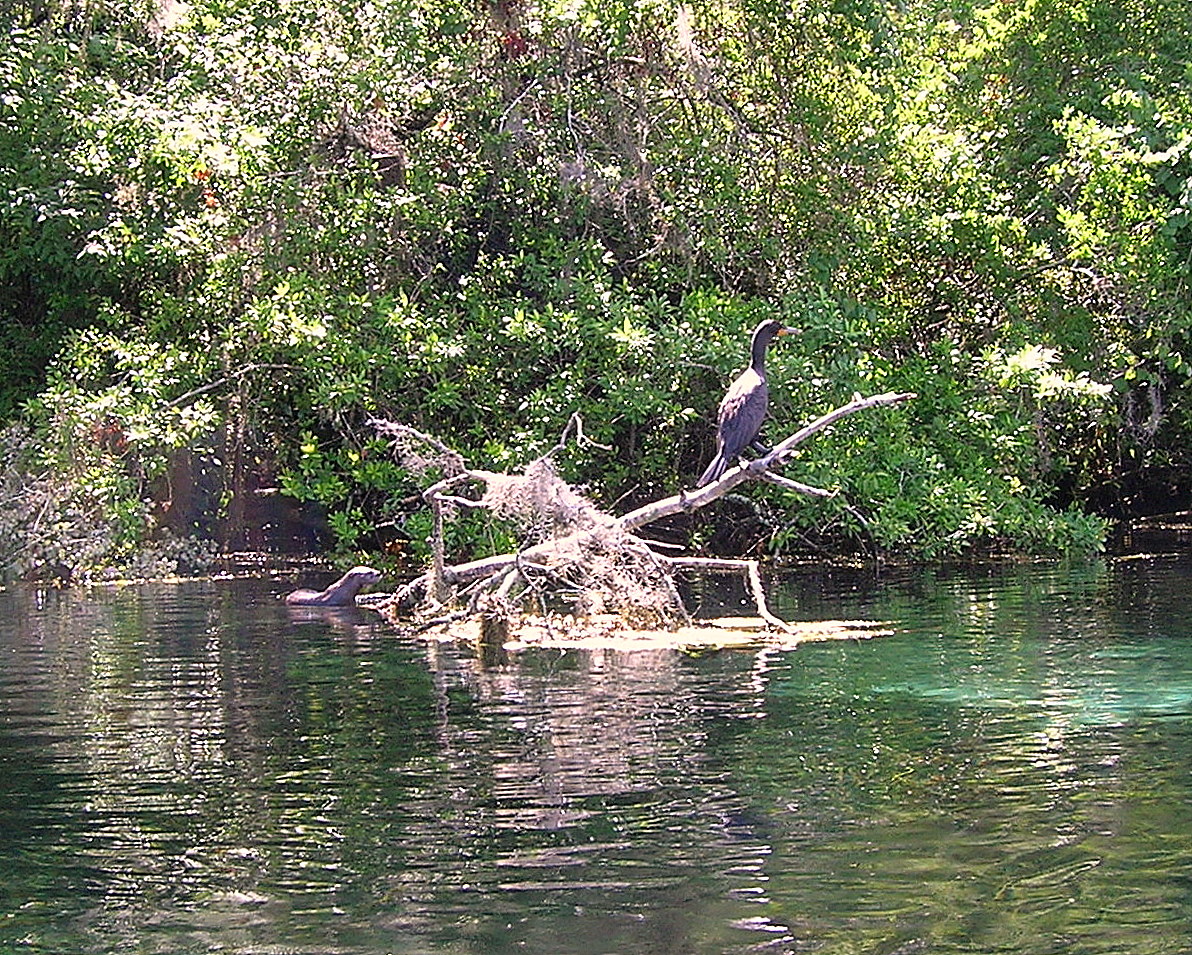
An otter climbs up a tree branch while a cormorant watches warily


The park at the main head-spring is one of the prettiest parks in the Florida park system.  A former Florida tourist attraction that went bankrupt in the middle seventies, a victim to both I-75 and the then newly-opened Disney World in Orlando, most of the attraction's beauty has luckily been saved. Closed for several years due to litigation and legal wrangling, the State of Florida eventually opened the head-spring area to all visitors.

Getting to the main park from the campground on the other side of the river requires a car, or bravery, if you are a cyclist. The short route, north to County Road 40 is around seven miles long. Riders must share the road with motorist doing 55 mph on both county roads as well as U.S. 41 as there is no bike trail or bike lane. The southern route is almost four miles longer, and just as dangerous. The main park, however, is a park not to be missed.

The walk from the parking lot to the entrance is a taste of the beauty of the park. Once inside the park you have two choices: To the right leads downhill to the swimming and paddling area, the other side to the once commercially-maintained gardens and forest. The head-spring area for swimmers and paddlers who flock to the 72 degree spring, especially on weekends, is very popular. I highly recommend visiting during the week, if at all possible. The forest trail has a low, wide paved path to the waterfalls, and a higher return path back to the gift shop. The gift shop, incidentally, doesn't open until 11:30am, and closes again at 4:30pm, so don't count on buying batteries if you get there too early.

Man-made waterfalls and cascades have been preserved as well as the foliage that dominates the area. The walking path leads to the Butterfly garden, and if you are lucky, you'll get to meet Charley, the volunteer who almost single-handedly maintains the beautiful area, and get to chat with someone who really knows his plants. The other side of the butterfly garden leads to several walking trails, one of them three miles long.


Swimming area at the Main park


The swimming side of the spring has a dock for swimmers, and a few hundred feet further downstream, a rental facility that has 20 Grumman aluminum canoes and 12 two-man Pamlico kayaks which can be rented for $10.00 an hour, with a two hour minimum. There can be a waiting list for rentals on weekends.  Years ago, glass bottomed boats took tourists for short, twenty minute excursions down the river, pointing out individual springs and hiding places for the Large Mouth Black Bass that helped make the river famous.

On Tuesday morning, we parked our Jimmy in the lot in front of  the gift shop at the campground location and walked the short distance to the river put-in ramp.  Luckily, we met the driver of the tram from the tube rental part of the park, the entrance gate we had erroneously pulled into during the rainstorm. On weekends, the concession has a full-time person on site all day, but during the week, you have to catch the driver of the tram as he has the keys to the boat rack and the required paperwork. The tram appears every half hour or so. After signing a waiver, leaving your driver's license with the tram driver, and paying your $20.00, you get to push off into one of Florida's prettiest, clearest rivers.

The water flow is consistent, but not overwhelming, as you paddle toward the head spring. The paddle is an easy 40 to 45 minute trip, with houses on one side of the river and wild forest on the other. About half way up the river, we met an otter which theatrically climbed up on a log for us so I could take a quick photograph. A Cormorant sitting further up the tree log watched apprehensively. Several children in a canoe started yelling about the otter and it immediately slipped quietly back into the river. We never saw it again.

The river is absolutely clear and every bass, bream, anhinga, turtle, or even cormorant, that swims anywhere near your boat is clearly visible. The absolutely crystal clear water is 72 degrees, and after a few minutes the water is actually comfortable enough to drag your hand or foot as you take a break from the leisurely paddle. We met many kayakers headed toward us from the head-spring area, with a few typically unconscious paddlers who probably drive their cars with the same total disregard for others as when they paddle.  Don't expect other paddlers to know what they are doing.  I HIGHLY recommend paddling on the river during the week rather than on weekends. We were told by the tram driver the past weekend traffic jam had backed up the county road leading to the park with tubers and paddlers. I can see why, this one of the nicest paddles we've done in along time.


This park rates as a “will come back,” one of the prettier parks in Florida.

More information about the Rainbow Springs State Park can be found at the official web site at:
https://www.floridastateparks.org/park/Rainbow-Springs

1 According to park rangers, the original campground markers at SR 484 were removed during road improvements by Marion County. At the completion of the road work, Marion county tried to charge the Florida State Park system $1200 to remount the signs, the Florida park system rejected the bill and the signs have never been remounted!
 
3 The $18,000 required for repairs was stricken from the State Park Budget by the 2011 Florida legislature.


Next Up: Oleno State Park at:


Saturday, May 21, 2011

Blue Spring State Park

My wife and I decided to stay at a Florida State Park at least once a month, beginning in May, 2011. Our first choice was Blue Spring State Park in Orange City, Florida, just a few miles off busy U.S. 17. Orange City is adjacent to Deland, and just north of Sanford, a fairly densely populated area about 35 miles northeast of Orlando. The trip would be a little over 200 miles, about four and half hours travel time. Ilse had changed her yoga class schedule - she's the teacher -  to allow us to have more time at campgrounds, and this would be the first of our series of four-day camping trips.

Scuba divers gather at Blue Spring

Ilse was home from her Saturday morning class by 9:30am, and we rolled out of our driveway with our pre-loaded travel trailer, headed north at exactly 10:30 am. The dogs were quiet and well mannered, acting like old hands at this. The temperature was typically May in Florida, comfortable in the middle 80's. By 1:00 pm, however, the thermometer had climbed to 95 degrees. 

Lovebugs were everywhere! This was the end of the second week of the bi-annual lovebug infestation and by now they should have been on the wane. Nope. We stopped a a gas station to tank up, at $3.89 a gallon, and spent 10 minutes cleaning the bugs off the windshield of our GMC Jimmy. The camper was an absolute mess! Splattered lovebugs all over the front of our once- pristine camper. No way to get to the top of the camper, it would just have to wait until we got home.

We planned our trip from Port Charlotte to avoid both I-75 and I-4, the most direct route, in favor of state and county roads up through the center of the state. We decided to jaunt across southwest Florida using state roads to Avon Park and pick up U.S. 27 for the main portion of the trip, remembering the route from days-gone-by. We were immediately introduced to the 21st century where the U.S. 27 corridor is a major growth area of the state and is a major bottleneck to expeditious travel. Scratch any future travel plans with U.S. 27! The trip was mostly stop and go, and the mileage really went from bad to worse. We finally got onto State Road 44 headed for Deland, just a few miles from our destination before we actually settled down and got to drive for any extended time without hitting the brakes. It took us almost six and a half hours to make the trip to entrance to the park.

Elevated boardwalk to the spring-head
The first indication things were a little different at this campground came as we tried to turn-off the two-lane access road into the park entrance. We were stopped by a park ranger while still on the county road. She politely asked if we were registered campers before allowing us to drive up to the park entrance. A second ranger held up a group of young motorcycle riders coming toward us on the dirt segment of the road to let us go first.  I parked on the far side of the park entrance - there is room for only three RVs there - and I walked back to the gate office to confirm our reservation and pick up our vehicle pass. I left the engine running with the air-conditioning on as it was now 96 and very uncomfortable.

The rangers told me this was one of Florida's busiest parks, especially on weekends. Bicycles and motorcycles were everywhere, so I didn't doubt them for a moment. I walked back to the Jimmy, hung our pass on the mirror, and carefully pulled back out into the roadway. I braked as I made the gentle turn and the brake pedal went to the floor! No brakes! I pumped furiously, but they didn't come back. I reached down to the trailer controller and turned it up full, using the trailer brakes to slow us down. The engine temperature came down as we started moving, and after 15 seconds or so the brakes began to come back. By the time we had traveled the two hundred yards to the campground turnoff, they felt as solid as ever. The engine never overheated or gave any sign of trouble, but the heat coming out of the engine bay was intense.

As we started into the camping loop, we were struck by the scrub look of the campground, Kind of a raggedy-looking campground with sites that didn't appear to be flat or even. They weren't! Most of them seemed barely suitable for tent camping, which appeared to be the primary type of camping at the campground. Very few RVs, but tent campers everywhere. Children of all ages filled the roadway.

Blue Spring meets the St. John's River

After we passed the first few campsite, we realized we couldn't find any site markers! There were no stakes, or posts, or any kind of sign with numbers! We knew the approximate location of our assigned site, but we couldn't see any indications until we caught a glimpse of a number embedded in the asphalt in front of the site. They were badly faded and mostly covered with sand! At least we now knew where to look. When we slowly approached our site, we did a double take as there was a car parked in what we thought should have been our site. I stopped and got out and verified our site number in the roadway. Sure enough, the squatter was indeed in site 20, our reserved site.

Ilse rolled down the window and informed the young, overweight woman who was still wearing a bathing suit, that we had reserved the site and were going to park there. The girl shrugged her shoulders and started giving us a story about her boy friend shouldn't have parked there, she didn't have the keys, blah, blah, blah, as she continued brushing her wet hair. I turned on my emergency flashers and we shut down right in the middle of the one-lane road. I told our squatter, “No problem, we'll call the rangers and they can tow you out.” Somehow, the keys magically appeared and she was in the car, a little front-wheel drive Honda, gunning the engine like mad. She dumped the clutch and the front wheels spun furiously in the sand. I watched as the little Honda sank down to the body panels in a cloud of white sand.

I walked over to her her as she sheepishly looked up over the steering wheel, a dusty cloud of sand slowly settling over the car. She looked at me without saying a word, waiting for me to react. I told her to put the car in reverse, turn the steering wheel ever so slightly, and SLOWLY try backing out of the rut she created. The little car got traction and slowly climbed back up on higher ground. After getting her to slowly drive around the ruts she created, she took off like a woman possessed.
An escape attempt from the gift store

After filling in the ruts, we finally backed into the site, but it was very difficult to unhook the trailer as the site sloped badly downhill. It was uneven to the side as well, but I corrected for it with the stabilizer jacks. Then we realized we couldn't find the water connection. The concrete post next to the electrical box was absolutely barren. The water spigot was at the front of the site, and luckily I didn't have to move the trailer to reach it and the electrical connection simultaneously.

We finished un-mounting the bicycles and leveling the trailer just as the first large drops of water started coming down. It rained hard and solid for the next several hours, so we tuned the TV antenna, broke open a bottle of wine and just relaxed. At least until the ground began to rumble and our trailer began to vibrate. The blast of a diesel train horn just hundreds of yards away was startling, to say the least. A quick check of the map noted “CSX transportation” adjacent to the park boundary. A major trunk railroad with plenty of traffic both day and night would make this stay really, really memorable.

The park itself is really nice. It is famous for its winter visitors to the spring: manatees by the hundreds. Weekends can be a test as the park is filled with children, teenagers, picnickers, kayakers, and certified scuba cave divers. There were so many waders and tubers in the shallow river on Sunday that the constantly flowing water was actually stirred up so badly you couldn't see the bottom of the spring basin. Monday was a different story, with mostly Australian, German, and other tourists taking snapshots from the boardwalk with only a handful of people in the 72 degree water. The thick foliage over the elevated boardwalk is beautiful, and the park is clean and well maintained.

Blue Spring State Park
We decided not to bring our kayaks with us this trip, and planned on renting kayaks from the park if we decided to paddle the spring. Paddling the shallow creek to the spring is out as they have a warning sign and ropes across the mouth of the spring, which is only several hundred yards in length. The kayaking is actually done on the St. John's River, and we decided we really didn't need to paddle that badly.

The two shower/toilets in the campground are old, but well taken care of. They were spotless, even after the hoards of children that parade endlessly through them on weekends. The camp hosts stay on top of the situation. The toilets, though, are hard to find by way of the primitive, unmarked footpaths through the underbrush. After walking the long way around on the paved road, we decided to try one of the paths for the return trip and only made one wrong turn.

On Sunday afternoon, a pop-up camper pulled into the site adjacent to us. The nice, middle aged couple approached us the next morning and asked us incredulously if we had known about the trains! The trains had blared their way through all night, giving only a couple of hours of respite. One night was enough for them and they headed for a different campground shortly after breakfast. One that wasn't located next to a train track, I'm sure.

The original Thursby house at Blue Spring

Dear friends drove up from Orlando to spend a very special day with us, strolling the short, paved path to the spring, and enjoying a nice, almost quiet, dinner. The park is a marvelous place to do just that.

Ilse and I spent the next day reading and writing, sitting in lawn chairs that we drug to whatever sparse shade we could find under the one oak tree at our site. We did enjoy ourselves, trying to guess which way the trains were headed by how far away we could hear the rumble.

We broke camp late on Wednesday morning and headed back down our old traditional route of FL 19 from Eustis to FL 33, then down a couple of cutoffs to bypass civilization and finally hitting U.S. 17, south back to our neck of the woods. The return trip took exactly four and a half hours, two hours less than the trip up. More lessons learned.

How do we rate Blue Spring State Park? A really nice day park, especially in the winter. We don't care much for the campground, however, as we really aren't into trains.

More information about the park can be found at: 
https://www.floridastateparks.org/park/Blue-Spring


Next: Rainbow Springs, from days past, at:


Wednesday, March 30, 2011

Kissimmee Prairie Preserve State park

The warning, “Do Not Follow GPS Instructions to the Park,” is posted some six or seven miles from the entrance to the Kissimmee Prairie Preserve State Park in central Florida. The park, located some 30 miles north of the town of Okeechobee, on the north rim of Florida's largest lake, was our maiden voyage with our new 20-foot travel trailer. The warning is posted so you can see it before making any serious wrong turns while listening to your favorite electronic directional convenience as you approach a T-Intersection on County Road 724, coming up from US Highway 98. It is a reminder of the warning found on the park's web page not to use GPS or Internet mapping programs to find the park entrance. The GPS and Internet maps are woefully wrong as most of their recommended routes are through a planned, platted community that was never built. The roads were laid out years ago, but simply don't exist! The actual wording on the warning sign may be a little different from what I remember, but the meaning is clear: GPS instructions will not get you to the park! Follow the brown, state posted markers and signs instead! The GPS may tell you to go right, but the state sign in front of you says go left! Trust the state of Florida here, they know where their park is. 


Ilse and I finally found a suitable trailer that we both really liked, a KZ Sportsmen 202. It had all the items we were looking for in a travel trailer. It was well built, lightweight, only 20 feet long, and we were able to buy it at the RV show price we had seen three months earlier. The trailer was on display at the Tampa RV show we had attended in November, and we had shown interest in it then. The dealer told us if we took delivery of it at the show, we could have it for a substantial savings. Unfortunately, we weren't prepared to pick it up at that time and had to leave it behind. We spent the next three months looking at travel trailers all over southwest Florida, but didn't find anything that satisfied our needs for a reasonable price. Finally, we decided to sell our little Cikira and put the money toward the best unit we could find.


The park main road.


We put our Cikira on Craig's list, and sold it to the second buyer to check it out. After the normal transactions, we watched our little “Chickee” get towed away with fondness. It had been a great trailer to get us started, but with two dogs, it was just getting too small. After checking RV dealers again, we found the KZ we had liked at the dealer's display up in Hernando County. After driving up to see it again, we were convinced this was the unit we wanted and bought it in middle February.

We wanted to take our new trailer on a short, maiden voyage before towing it up to Georgia and we went on the Internet http://www.reserveamerica.com/) to check availability of campsites at the many near-by Florida State parks. No openings at any State campground within 200 miles until April!

Many years ago, while watching television with my fiancee and her mother one evening in Bitburg, Germany, I had suddenly laughed out loud!  I had finally understood a German joke! I had struggled with my basic German as I tried to process the overload of linguistic information coming from the surprisingly alien medium. I quickly understood the shortcomings of the German language night classes I was taking at nearby Bitburg Air Base, where I was stationed.

The joke? Well, it seems a fellow who lived in Frankfurt was complaining to a friend that he had sold his car the day before. The friend asked, “Why should you be sad because you sold your car yesterday?“ 

His friend answered, “Today, I found a parking space!”

That joke came back to mind after all these years when my wife and I tried to find a camping spot recently for our new travel trailer. We struggled for hours searching the Internet trying to find a spot anywhere in the Florida State Park system for Friday, February 25th. We had hoped we could find a spot not too far from where we were picking up our brand new unit. We wanted to stay overnight close to the dealer should we have any problems. There were no openings at any Florida State Park! None! One single campsite finally opened up at the Kissimmee Prairie Preserve State Park, about 70 miles away. One space in the entire state system. And this isn't just for one night, we found there were few openings for many weeks to come!


Kissimmee Prairie Preserve State Park - Site 14


There are really great commercial campgrounds with fantastic amenities as well, but, no matter, they were also full. We aren't great fans of some of the lower-end commercial sites where campers are packed in like sardines and then get charged upward of 40 dollars a night, plus a three dollar surcharge for electricity. We prefer to have a little breathing room, and a little more privacy when we camp, but we would have suffered even a spot at one of those just for a space to park and try our new camper.

We have found that most state parks, and more than a few county parks, offer excellent, inexpensive facilities. One of the most famous county parks is Ft. Desoto County Park, in Pinellas County, but trying to get reservations there during the snow-bird season is next to impossible. The same goes with most of the Florida State parks, and the few U.S. Army Corps of Engineer parks in Florida. If you can wait until after Easter, you might be able to wrangle some time during the week, but don't hold your breath if you want to camp on a weekend.

Ilse and the Carolina Parakeet


The snowbirds descend on Florida annually and fill up the campsites until after Easter. Finally a site opened up at the Kissimmee Prairie State Park and we grabbed it. I honestly don't know if I would have picked this park otherwise, but it turned out to be a great choice!

We rolled out of Port Charlotte a little after 11:45 am, and were checking in by 2:45pm. The weather was clear but incredibly windy! The strong, 20 mile an hour headwind dropped our mileage to a terrifying eight miles to the gallon! We would not be taking any long trips if this were the norm with the new trailer. We had gotten well over 13 MPG bring the trailer back down I-75 from Tampa, and were stunned by the drop in mileage during the short trip to Kissimmee Prairie State Park. We were loaded with food and some water as I usually travel with just enough fresh water in the tank to emergency flush the toilet. The little Jimmy was straining even though we only had our bicycles with us. We rarely went over 50 miles per hour the whole trip.


The entrance to the park is a 5-mile long dirt road, well graded and maintained. Why it is called a prairie is immediately obvious as you can soon see horizon to horizon. There is one turn in the road before you see the campground clustered under the oaks of a nearby hammock. The main gate, which is closed at night, is five miles from the campground, but the first RV site in the grove, or hammock, of live oaks is the campground host. We slowly drove into the campground, looking for registration hints, and stopped abruptly when we heard the camp host yelling at us. We drove right past him without seeing the camp host sign. We picked up our registration tag and a campground map, apologized to the host for not knowing the protocol, and slowly drove on through the small campground looking for our site. We backed into the oak-shaded site with no problem and began to unhook and set up camp. Soon, a golf cart rushed up and the camp host excitedly informed us they needed to see my driver's license to prove I qualified for the discount given to senior citizens. Everything was in order and we were soon walking the dogs through the windy campground. Later, we could not get our barbeque grill to stay lit in the wind, so we decided to save the open air cooking until the weather calmed down.


Count the alligators - Mama Gator and brood


There are two loops at the campground and the prime loop is unique as it is designed for equestrian campers. The park is actually friendly to horseback riding. Pens are available near the wide campsites on that loop.

We were up early the next morning, but the wind was as fierce as the day before. The temperature was cool, and the sky was absolutely clear! We took the dogs for a walk around the campground and found a ditch with just a little water in it, between the two camping loops. After staring at the mud for a moment, I realized I was looking at an alligator's head sticking up in the muddy water! A mother gator was guarding a nest of young hatchlings that were camouflaged on the muddy bank. We counted eight babies, while at the same time making sure the dogs stayed on the other side of the road!


As we walked around the outside of the equestrian loop. I was startled to see a row of telescopes set up along the far edge of the road. The ranged from huge, trailer mounted telescopes to consumer types on tripods. This park is famous for darkness as it is far from any light pollution, and many campers sleep during the day and spend all night studying the heavens from a really great vantage point. Another unique feature of this park not found at the busier, more heavily visited parks.

We saw our first Caracara, a black and white eagle that is the national bird of Mexico. There are several nesting families of Crested Caracara here, as well as a statue of the of the Carolina Parakeet, the last native North American parakeet that once flourished at this park.

We only bicycled in the campground as the shell and sand roadway occasionally was unsuitable for the road tires on Ilse's bike. We walked the short, but pretty trail between the two campgrounds, and drove to the nearby slough to watch a few more gators sunning themselves. Mostly we read and just enjoyed the quiet and solitude.


 We awoke Sunday to heavy fog, soon blown away by the winds as they once again became stronger than normal. We again enjoyed a day of rest and reading, and walking the dogs. We were doing a daily check on the alligator family. Sunday night we prepared the camper to pull out early Monday morning. The trip home was a breeze, so to speak!  With the heavy winds at our back we got 13 miles to the gallon!  I guess we can only travel with the wind behind us.


The shower/toilet facility spotless and easily accessible. The sites were wide, level and clean, and as always, each had a picnic table and fire-pit. The park is unique for stargazers and horseback riders. We may again visit, especially during the Perseids meteor shower later in the year. 


Next: Blue Springs State Park near DeLand, FL, famous for the Manatees at


Featured Post

The Waterfalls Trail

After several days of hiking and walking shorter trails to build up our stamina, we decided today was the day to descend the Waterfall T...