Tuesday, July 17, 2012

Seven Points Recreation Area - Raystown Lake

The road up from Jennings Randolph Lake in West Virginia is a pleasant ride through the slowly diminishing mountains as they turn into the Alleghenies in southern central Pennsylvania. We follow US 220 from Keyser for most of the trip, turning off some forty or so miles from Raystown Lake. The road runs mostly along the valleys, following the rolling contour of the land north, except for the short, gut-busting climb just before we get the Campground entrance.

The roadway pull-off at the main gate is angled so the quick trip to the registration office is short and painless. The pleasant, young attendant informs me almost all of the 246 campsites will be filled for most of our stay, so he hopes we will be happy with our on-line selection. He tells me the on-line system is down, making that the third time I have heard that story in the last three weeks at three different campgrounds. I'm beginning to wonder if that isn't just a standard answer. Switching campsites will prove to be difficult if we aren't satisfied. We also find out none of them have water at the pad. Obviously, that isn't a hindrance to the campground's popularity, and we soon see why.


Our first impression of the huge facility as we drive in is really good. The Raystown Lake project is over thirty miles long and appears to be extremely well utilized. Almost all of the visitor's or camping facilities are actually run under contract rather than the Corps itself. The Seven Points Campground is run by a non-profit organization known as the Friends of Raystown Lake, and they do a really good job of keeping the place spotless. They honor the Golden Age Passports and America the Beautiful passes where some concessionaires do not. They also run a busy marina as well as a restaurant and a ship's store. In addition, the world famous Allegrippis mountain bicycle trails are part of the recreational system they maintain, the trail head being just a few hundred yards past the main entrance to the recreation area.

There is another area some fifteen miles south known as Lake Raystown Resort and Convention Center, on Corps of Engineers property, but not run by the Corps itself. They offer lodges, a convention center, cabins, a marina, and another 200 or so camping sites, but they are run by a commercial organization and do not accept the age-based passes many retirees count on. Their campsite prices are considerably higher than any of the Seven Points campgrounds, but claim most of their sites are on the water while Seven Points only has three campgrounds on the lake itself. I'm afraid if the political powers that want to commercialize all Federal assets have their way, the middle class campers will be basically locked out of the facilities we now enjoy.


This is the first Corps of Engineers facility we have visited that has more than one campground at the main location. In fact, it has six campgrounds inside the main gate. Our campground, Bay Camp, is not on the water. We've always had full hook-ups everywhere we've camped in the past. In the four years we have been RVing across Florida and Georgia, we have never had less than 30 amp electrical service and potable water at our campsite, regardless of where we were or the agency that ran the facility. The Robert W. Craig Campground at Jennings Randolph Lake was our first campground with only community water. The Seven Points Campground at Raystown Lake, Pennsylvania, is our second.


At first glimpse, Bay Camp seems to be a barren, featureless campground and we are extremely disappointed. Our first thought is this is the least appealing campground we have had yet. It is a single road with a turn around loop at the end. Sites are across from one another for the first half of the road. There are campsites on only one side of the road once you get past the toilet facility, and our site has privacy in front and behind of our pad. The pads themselves are gravel, but appear clean and level. Not as much space between sites as at Robert W. Craig, but far better than Goose Point.


We slowly creep along, looking at signposts and find the people in 160A, our assigned campsite, are still there. They will be there awhile as they haven't started breaking camp yet. Bicycles and towels litter the camp site. We look at the time: 2:45 pm, we are too early, they have until 4:00 pm to check out.

As we slowly drive by the campsite, two large, unleashed dogs run up to the car from site 161, our potential neighbors. Taz, our Golden Retriever mix, immediately responds with snarls and barking, his head as far out the window as possible. Ilse immediately has words with the seemingly disinterested owner who waddles over and seems shocked when my wife informs her dogs must be leashed. Oh well, back to the main gate to see what is available elsewhere in the recreation area.

Again, the young attendant, not as happy this time, informs me while we can switch sites three times to fit it in, there are no other sites in the entire facility open for the time we need. I complain about the untethered animals, and the attendant seems almost disinterested. I up the tension somewhat to make my point about the seriousness of the matter, and demand a ranger visit the campsite. He gets flustered and annoyed, guaranteeing me he'll call as soon as he gets a chance.


With a sense of resignation, we head back toward our reserved site on the Bay Camp campground from the main gate. Unable to change our location, we decide to make the best of it, after all, we will be here thirteen days! We stop at a communal water spigot on our way back from the unplanned trip to the main gate and top off our fresh water holding tank. There are potable water filling stations located in the same area as the multi-lane dump station so filling with fresh water up on the way in to the campsites is no problem. We used the spigot in front of the really nice and clean showers in the Ridge Campground to fill up. We will be staying in that campground on a return visit in August, and are happy to find just not showers, but Ridge Campground is also the only loop with coin operated washers and dryers. But, it is also the furthest campground from the lake, so there is always a trade-off.

We will have to unhook once while we are here to dump our gray water and black water holding tanks. We will try to limit our stays in the future at any one campsite to no longer than it takes to fill the tanks. It is the only way we have to avoid the exercise of hooking up and moving the trailer just to dump our waste water. There are alternatives available, such as a small, portable waste tank that is used to empty black water tanks without moving the RV, but we haven't yet found a solution for our small trailer. The problem is space.

Most of the little plastic, towable sewage tanks are simply too big to store any where under our little trailer. Most larger fifth-wheels and class “A” RVs have storage space under the unit to accommodate the little intermediate sewage transport system when not in use, but there is no room for one in my 21 foot long KZ Sportsmen. I certainly have no intention of carrying the empty little septic tank in my SUV! The towable units come in many different sizes and colors. One of the more popular brands is bright blue, and many campers simply call the little plastic wheeled, tow-alongs, regardless of its actual color, “Blue Boys.” As with everything in life, you get what you pay for.

The larger tanks, in the 27 to 35 gallon range, all have automatic stops to prevent “messy” overfilling, while the smaller ones such as the one 12 gallon model that might actually fit under my unit, has no such safety against overflow. Just use long, industrial strength rubber gloves and a good sense of timing or your 26 gallon trailer tank will overpower the little 12 gallon portable unit, and you will wish you had just moved the camper to the dump station instead. I can only imagine the difficulties in cleaning a pad that has no water connection!

We have watched many campers go through the routine of emptying their “Blue Boys” at dump stations, often with fairly humorous results. The unmistakable rumble the unit makes as it is dragged at less than five miles an hour through camping loops en route to the dump station is a well known sound at every RV campground. We watched one elderly camper who reminded me of Don Knotts try to tip a rather large portable unit to empty it while at Goose Point. I decided then and there if I ever use one of those things, it will be in the dead of night when everyone else is asleep.


We have no choice but to kill time at the really nice visitor's center, where we chat with the woman who runs the gift shop. There is no information more valuable than from a local resident, and her information and insight immediately makes it clear to us this is an area we want to see. She tells us to come back at 9:30 in the morning for a vendor's showcase. We'll have a chance to win door prizes and pick up all kinds of brochures and passes. They'll even have free coffee and doughnuts.

Four O'clock rolls around and we slowly head back to Bay Camp on the one-way winding road past the huge marina and the boat ramps, not knowing what to expect. We slowly roll into the half-empty campsite, carefully looking for the dogs. Our campsite has been vacated, so we have no problem backing in. We carefully look around the campsite, our neighbor's dogs are nowhere to be seen. The pop-up is still there, but the dogs are gone.

Again, we really appreciate the Corps of Engineers parks and the people who run them. They have little tolerance for those who won't abide by the rules.


NEXT: Enjoying the lake at Raystown aboard the Princess, at:


http://sleepstwo.blogspot.com/2012/07/other-princess-cruise.html


Saturday, July 14, 2012

Robert W. Craig Campground


The Robert W. Craig Campground at Jennings Randolph Lake is an unexpected first for us; there is no water hook-up at any of the campsites. There is water available at various central locations around the campground, but there are no individual water hookups at the campsites. I was caught somewhat off-guard because I made the reservation under the impression each site had water and electricity. Oh well, time to learn more about RVing.


We end up with a community spigot conveniently not far from our pad, but we can't hook to it other than using it to fill our 26 gallon fresh water holding tank in the trailer. No problem, using two water hoses to reach the spigot, Ilse holds down the spring-loaded handle while I turn on the trailer pump and go inside the trailer to monitor the gauge. It takes about ten minutes and we are set for the three days we will be there. We take a shower in the trailer that first night instead of using the campsite facility just to see how much we use. After one day we are comfortable with how much water we actually need, and are no longer concerned about future campsites were we might not have a water hookup.

The campground is almost full when we arrive with only a few empty sites. I consider the campground fairly remote as every road to the campground is considered “very hilly,” or to a Florida boy, “mountainous,” but it is quite popular, especially on weekends. Most of the license plates are from either West Virginia or Maryland, with only a few from other states. The locals probably don't even pay any attention to the roads.


The pads are paved, spacious and clean, and the grounds are well mowed and maintained. We are on the second loop, and while the toilets are the usual clean, well lighted facilities, the only showers are on the first loop. The first loop also has a really nice playground for children. Deer run through the edge of the first loop as we walk the dogs, children playing not far away don't even notice. The camp ground is serene compared to Goose Point, even though the Robert W. Craig campground is full.


With tent campers and pop-ups everywhere, just like the Virginia campground, this one is laid out with enough space and greenery between pads to absorb the crowd without imposing on anyone's space or privacy. A really nice campground.


The next morning we drive to nearby Westernport, then to the closest large town, Keyser, to get gas and do local sight-seeing. We drive past the back gate of the huge Kingsford charcoal plant as we descend the mountain on a West Virginia county road from the campground. We eventually circle the entire Randolph Jennings Lake just to see the area. We stop to take photos of Luke, the picturesque town across the valley and watch a deer run along the edge of the road behind us. It turns and runs through a gate beside the charcoal plant. It acts as if it knows where it is going.


The booming industry along the rivers and valleys of this area of West Virginia seem to be around every bend. They are in stark contrast to the endless miles of closed plants in Bassett, Virginia, where we stayed at the nearby Goose Point Campground. Plants and industry seem to be an endless array of buildings along this narrow stretch of the Potomac River. The area has great natural beauty, and many resources used by industry as well.


They seem to be doing a pretty good job of keeping it balanced. Gone are the days of smoke filled valleys from steam engines and open coal-fired smokestacks. Back in the fifties when when our dad used to drive the family through West Virginia, we kept our windows up, regardless of the temperature. We couldn't stand the stink and eye-burning smoke. The nostalgia people have a tendency to overlook these things when they reminisce about the past.


We stop at the official Corps of Engineer viewing site, look at the Waffle Rock, pick up a few brochures, and decide when we leave on Monday we will back-track about fifteen miles or so to avoid the county road out of the park that led us to the charcoal plant. The road is just too primitive for my taste, I would rather stick with the road we drove in on.


When we wake up Monday morning, we find we are all alone. Of the ninety sites, only six are occupied. Very few cross-country campers seem to stop here. As with the facilities at Philpott Lake, the majority of users seem to be local inhabitants who take advantage of really great facilities mainly on weekends.


We plan on leaving later on Monday than normal because we only have a four-hour drive to Raystown Lake in Pennsylvania, our next reserved campsite. Check in there isn't until five in the afternoon so we take our time having breakfast and breaking camp. The weather is cool, the skies are clear, and the scenery is just beautiful. Plus, we have the road to ourselves. RVing doesn't get any better than this.


NEXT: On to the most popular campground in the U.S. Army Corps of Engineers system, Raystown Lake, Pennsylvania, at:


Friday, July 13, 2012

Time to Roll - The Flexibility of RVing


Family Reunion

Goose Point is another campground often dominated on weekends and holidays by local users, most of them either camping in tents or small pop-up trailers. With clotheslines everywhere, extra vehicles jammed in every available nook and cranny, space was at a premium, and unfortunately, so was privacy. This large group has made meeting at the campground an annual family re-union ritual, this being the tenth year they have met at the same campsites. They will be here all week.

Are they gone yet?

One couple arrived at the small, nineteen site loop sometime during the week with three Labrador Retrievers, and refused to leash their dogs. We decided to pull up stakes and leave Goose Point three days earlier than planned. We don't need another experience like the one we had several years ago at Lake Tobesofkee in Georgia. Besides, we can only take so much togetherness, so to speak.

The “A” Loop campground is simply too small to handle every site being occupied, especially when almost every site has guest vehicles. The lower “C” Loop is a little better. The middle level “B” Loop by comparison, is virtually empty the entire time we are there, and that includes the Fourth of July holiday. No electricity and only several centralized water spigots in the “B” Loop are the main reason the tent campers elect to pay for a full hook-up campsite in the other loops. They deprive the RVers who cannot access the “B” loop as it is designed for very small campers, not travel trailers or RVs. Another reason dry campers avoid the loop designed just for them is the toilet. The camper's facility isn't conveniently located like the toilet facilities on the two RV loops.


Ooh Noo, Mr Bill!


After talking with Harv and Lynne from Maryland, a couple camped on the other side of the “A” Loop, we head into Martinsville and use their public library for access to the Internet. Harv and Lynne also like camping at Corps of Engineer's Campgrounds and highly recommend the Robert W. Craig Campground, at Jennings Randolph Lake in West Virginia. They warn us about the mountainous roads to get in and out of the campground, but also tell us the campground is one they really like. Confident the Toyota Sequoia is up to the task of the mountain roads, we cancel the last three days at Goose Point and find a rare slot at Robert W. Craig for the three days. It is a 290 mile tow, a good days tow, especially in the mountains.

The official paint sample collector

We are up early Friday, and quickly do all the pre-move chores in an eerily silent campground. We carefully and slowly maneuver the trailer through the excruciatingly tight, down-hill left hand left turn we have to make to exit the “A” loop. Ilse walks alongside me with one of our little yellow Motorola radios and carefully monitors our clearances, especially the blind spot on the other side of the trailer. Almost as soon as we clear the left turn, we must make another hitch-crunching, right-hand turn, also down hill, to get to the dump-station at the bottom of the hill. The many multicolored paint samples left on the steel post for the gate hinge testifies to the sharpness of the turn.

We use the campground toilets as much as possible, but our holding tanks are both full and the dump-station stop is mandatory before we leave. I do not recommend the “A” loop for any trailers over 24 feet, although we saw several trailers there that were in the 32 foot range. I can only imagine how much fun they had getting out of there.

Ready or not, here I come...  Backwards.  The only way out for big rigs at the "A" loop

The largest unit we saw was a 37 foot long Class “A,” one of the self-contained diesel powered pusher RVs that couldn't make the turn to get out. He simply could not negotiate the left turn. Another fellow camper and I had to block the access road and slowly guide the RV backwards down the tight hill. With only his TV camera to guide him, he was basically blind without us. He had no choice but to back down the road, and he couldn't do it alone. It took several minutes, and several tries before he finally backed down to the main camp road, and made the turn to the dump station. He didn't even thank us, he simply slammed his huge rig into gear and roared down the hill.

US 220 to Roanoke

As we head toward Virginia Highway 57 on the five mile, super twisty access road, we decide to forgo our painstakingly selected scenic route through the foothills and go with what we know to be a quicker, painless route up US 220 to Roanoke. There we pick up Interstate 81 and head north toward our turnoff to the mountains at Harrisonburg.

We pass signs reminding us of the Civil War battles fought all along the valley. My great grandfather, Robert Stubblefield, was wounded and captured at Winchester, a little north of where we turn off the Interstate. I have never visited Winchester before, but we will be back through here in September and I make a note to stop on the way home. The famous Natural Bridge is another attraction we pass on the way up that I want to see on the way back. Many things still to do.

Really, Dollar General? Come wipe your feet on our flag?

Finding US 33 is no problem, but following the ill-marked road signs through Harrisonburg leaves a lot to be desired. The road signs drop us in a residential neighborhood, and that's it. It has been a long, long time since any Virginia DOT people have followed their own road signs. This time our little GPS does the trick and guides us back to the highway and soon we are rolling west on the fairly smooth, two-lane highway toward the mountains. After we clear the often unsightly outskirts of town, the farms and countryside along the gently rolling hills begin to look more and more how I remembered traveling through the rural south with my parents when I was a child.

US 33 through the George Washington National Forest

The ride through the George Washington National Forests remind us how beautiful our forests can be when not spoiled with the infestations of humans who do not care. The highway through the dense, dark forest is straight and several miles long, a very pretty ride. The forest road is in stark contrast to the ride through gently rolling farm lands and pastures that precedes it, and the drastic mountain climb that ends it. The end of the forest is as big a shock as any I have had towing a travel trailer.

The highway makes a sharp up-hill left turn and I find myself in the mountains! We are climbing steeply and sharply before I have time to blink. I haven't done 9% grades in a long, long time, and certainly not with the constant switchbacks that seem to have me looking at my own taillights! The Toyota shifts down and we grind our way for the next twenty minutes or so until we crest the top of the first mountain, a line of cars and SUV's strung out behind me. Then we get to check our trailer brakes as we immediately descend the other side of the mountain, also at 9%! I look at the warning signs for truck runaway ramps with great interest! Several of them show signs of recent use.


By the time we reach our turn to Jennings Randolph Lake several hours later, I feel like an old hand at this. My arms are tired, anyway. We make at least five climbs and descents before we eventually get to our new campsite at Robert W. Craig Campground, the last two unnecessarily.

I carefully keyed the coordinates of the campground from the Recreation.gov website into the GPS before we left Philpott. I made sure to use the coordinates of the campground and not those of the lake itself, so I was fairly confident my little electronic treasure would get it right. As we approach Elk Garden, a road sign shows WV 46 and the Jennings Randolph Lake veering slightly to the right. The sign is in front of a right hand curve, so, to double check if I slow down even further and check the GPS. There doesn't appear to be a highway turnoff after the curve, just an unmarked driveway to the right. The trusting GPS paints a solid purple line straight ahead, no turns, on the road we are on, so I start down yet another mountain into the small town of Fitzmiller, which we soon learn, is in Maryland. We grind our way up yet another small mountain on the other side of the small town located on the small, rocky stream known as the North Branch of the Potomac River, where our GPS soon dutifully tells us to follow a newly tarred gravel road to our destination. Time to stop and call the campground. Yep, we are on the wrong side of the lake.


This time it isn't the fault of the GPS programmers. Nope, it is the website www.recreation.gov that posts the wrong GPS coordinates that take us over an hour, and about 25 mountainous miles, out of our way. Not to mention a freshly tarred road we didn't need to travel. Of course, me not correctly reading the road signs back in Elk Garden was also a mistake. I should have stopped then and called the campground. The coordinates posted on the reservation web site for the Randolph Jennings Lake Corps of Engineers Park are actually the coordinates for the observation lookout on the Maryland side of the huge project. The Robert W. Craig campground, where we have reservations, is of course on the other side of the lake.

NEXT: Robert W. Craig Campground, 


Thursday, July 12, 2012

Two More Firsts at Philpott


I always haul a small leaf-blower along to clean off debris from the campsite, but until now have never used it. A small broom has always sufficed to clean off what little dirt or leaves we track onto our big front mat. I use the blower for the first time Saturday morning to send the mass of leaves and branches left over from the storm that passed through the night before over the edge of the pad and into the abyss. It works like a breeze, so to speak, and within a minutes, the campsite is once again clean.  Another reason to always carry an extension cord.

The new world of tent camping:  A wide screen projection TV shown against a tarp.
Another first is when a park attendant asks the people on the other side of us to leave. They arrived late the evening before with a pop-up trailer, one of the easiest to tow of all camping trailers, but one with the least amenities. With a lift up center section, fold out bunks and canvas walls, it has to be unfolded and assembled before use. Many pop-ups have small air conditioners as part of the package, but few have any type of toilet. Some of the better fitted ones have a porta-potti arrangement, but it is still closer to tent camping than we like. This one has a dog. A big, loud, black Labrador mix that barks at everybody, all the time. It barks constantly until someone has enough and the park attendant finally drives up and chats with the owners. They are gone in half an hour. This is the first time we've seen anyone evicted from a campground. We just love Corps of Engineer parks.

The group next to us on the other side prove to be good campsite neighbors. Several families joined forces to bring boats, tow-tubes, food and a lots and lots of kids. They share several campsites spread around the campground, but the site next to us is the chuck wagon/dining hall. It is fun to listen to the dads quietly mete out instructions and stern warnings that were absolutely adhered to, with the sing-song, North Carlina accent. The kids are great. Well mannered pre-teens and teens alike. Especially the one who went over his handlebars to keep from running over me when I step out from behind my Toyota on the way to the toilet. He is taking a high speed, down hill detour against traffic to avoid a pickup truck coming through the one way loop when he picks the front of our campsite to cut across. He pays the price dearly, but he doesn't hit me. He even apologizes as he gets up off the pavement.

Saturday turns out hot, and the campground is soon packed with locals who use the lake on weekends. Ilse and I forgo the outside activities and spend the day in the conditioned camper, watching a DVD. The campground is full and we are surprised by the number of tent campers who have rented regular water and electric hook-up RV sites. The center loop, dedicated to tent campers, is empty. Tent campers like the centrally located toilet of this loop, and above all else, the electric power. We found one canvas tent with an air conditioner propped up on a card table, blowing into the tent. They mainly want to use the electric outlets it seems as many bring fans. Kids on bicycles fill the narrow roadway, and we envy their immunity to the heat. By nightfall, campfires are burning throughout the campground and everyone is happy.

Sunday dawns quietly. Everyone is sleeping in. The songbirds have regained control of the forest. Ilse makes coffee and pancakes and after breakfast, we turn on the TV just to catch up on the weather. A rainstorm is forecast, and as we watch the news, the sky around us turns dark and blustery. We seem to have a knack for seeing the warnings just before the events hit us.

 Winds pick up, and within minutes, hail the size of marbles begin pelting the campground. I quickly drop the canvas awning down as far as possible, not enough time to put it away properly, and make sure we can still open the camper door. The group next to us is up making breakfast when the hail hits, and they immediately run under a canvas shelter that doesn't look like it will offer much protection. But everything holds up, and within a few minutes, the hail turns to rain. They begin breaking camp, they have had enough. They clean up all the sites and are gone in half an hour. Ilse and I are happy, we know Sunday night is traditionally the quietest night of the week at a campground. Aah, the weekend is over, our peace and quiet will soon be here!

Beavers?  Nope, thoughtless campers who wouldn't pay $5 for firewood!

Our solitude is short lived as tent campers begin to fill the vacated sites. Where we usually find empty campsites, we find multiple tents. I forgot it is Fourth of July week, the popular National holiday falling on Wednesday, right in the middle of the week. One group of kids is replaced with another. By night fall, groups have link campsites with each other and we realize this isn't going to be a quiet night, probably not a quiet week. All the sites are filled except one. Campfires are aglow all around the campground. Somebody even thoughtfully brought a barking dog.

NEXT: On the Road - Philpott Lake to Robert Craig - 


Wednesday, July 4, 2012

Salthouse Branch Campground, Philpott Lake, Virginia

On our way back from nearby Collinsville to refill one of our 30 pound propane tanks, we take a side trip to the other side of Philpott Lake to visit one of the other campgrounds run by the Corps of Engineers. The closest campground to Goose Point is Salthouse Branch, about fifteen or so very twisty miles by car from Goose Point, but only an easy paddle across the lake by kayak. The Salthouse Branch campground is about twelve miles from the town of Bassett. The road to the campground is almost as twisty as the one to Goose Point, but it is in worse shape. It is a county road and not mowed or maintained like the roads inside the Corps of Engineers property. Again, not for big units or careless drivers. 
We are immediately struck by the major differences between the two locations. The first loop of Salthouse Branch looks to us like a commercial type campground. Sites are laid out in a measured grid at a slight angle to each other, close with no separation between sites. No trees or vegetation, just grass and pavement. Not our cup of tea, but if you want to take advantage of two great swimming areas and an easy access boat ramp, this may be for you. 

This camping area is close to a great put-in point for kayaks, but a good hike from the main boat ramp. This loop is the only one that can accommodate larger trailers or RVs. The rest of the campground is strictly for small camping units, this campground is a far tighter park than Goose Point. In fact, a warning sign posted on one loop warns “No Trailers Over 20 Feet.” They aren't kidding. On the road out from that loop, I couldn't see the edge of the pavement on my driver's side, while I was guessing about how close I was to scrapping the right side of the Toyota on a tree trunk. There isn't even room for two passing vehicles on most of the narrow access road to the beach area! The two swimming areas here are the saving grace, and I'm sure the day user's take full advantage of the facilities. 


NEXT: Philpott -


Wake Up Call at Goose Point

We spend the first Friday, our fifth day at Goose Point Campground, doing unscheduled chores. We drive to nearby Collinsville to refill an empty propane tank in the morning, and later in the day we head to Bassett to catch up on Internet stuff. We still haven't spent a complete day just goofing off around the camper. We haven't even blown up the inflatable kayak we borrowed from our daughter yet.

The Rusty Buckle of the Bible Belt.  The huge factories at Bassett are all closed

Friday is our first really uncomfortable day as the temperature soar for the first time of our trip. We drive into town after a late lunch to use the Bassett Branch of Blue Ridge Regional Library's free Wi-Fi, but find they closed at 2:00pm. We drive a little further to a nearby McDonalds restaurant and use their free Wi-Fi to effortlessly log on instead. We want to upload photos from the family reunion and check e-mail. You know, the very stuff you go on vacation to get away from. We did catch up with the latest installment of the Danish television series, Borgen, a show we really like to watch. Glad it has subtitles, the restaurant is not great for sound from a laptop PC. But, on the other hand, try and sit there and not have an order of French fries.

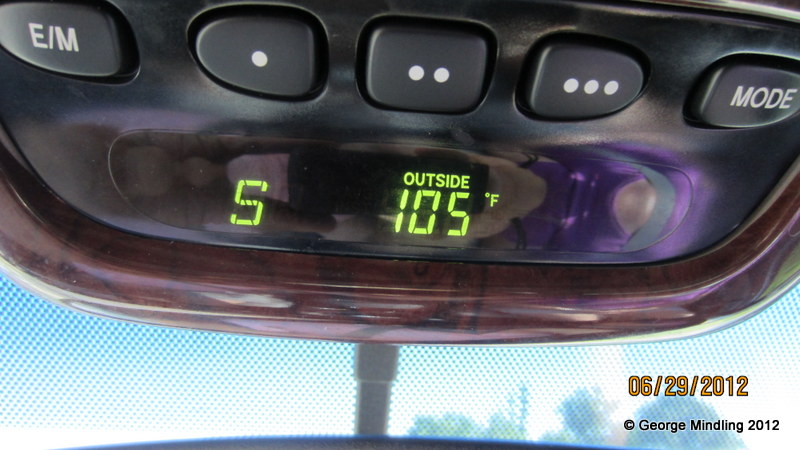
The heat hits us full blast when we walk out of the fast food restaurant. Not much humidity, but hot with a capital H. It is 105 degrees when we first open the SUV, but soon cools off to 103. We drive back to the campground where it is in the mid-nineties and have a great impromptu dinner of Ilse's special fried rice. We eat inside the camper as it is just too unbearable outside. We settle back for a quiet evening as the campground rapidly fills with weekend campers, mostly it seems from North Carolina.

Our solitude is lost, but we know come Sunday evening we will have the campground to ourselves once again. Serenity will once again fall on the southern Virginia forest. By the time evening falls, the once vacant campground is packed. Kids on bicycles everywhere. Typical for a weekend on a lake-front campground. Ilse and I retire to the trailer and kick back, relaxing while the neighbors next to us laboriously chop down a small tree for firewood.

Technology rules!
After reading the first few chapters of her newly downloaded novel, Ilse idly turns on the television only to see storm warnings for all of western Virginia. A storm front that engulfs the entire Allegheny valley had suddenly developed and it is headed east at over 40 miles an hour! It appears we are going to be affected, it is just a matter of how much time we have to prepare for the predicted sustained winds of 50 mph, with gusts up to 80. I find out when I open the trailer door! Tree limbs and branches are already blowing across the darkened campsite.

We quickly take off the string of camp lights that I attach to the awning frame and retract the awning. We put the folding chairs in the back of the Toyota, clean up as best we can in the yellow light of our camper's meager porch light. The blustery winds continue to pick up. We watch the helpless tent campers next to us who had just finished assembling their elaborate canvas fortress. We tell them what we know about the storm warning the same time the park attendant and drives up and asks if everyone is tied down. The next-door campers from Winston Salem are concerned, but decide to ride out whatever comes as it looks like we are only going to get the fringe of the storm.

Safety is the responsibility of the individual camper


The winds come suddenly and brutally. The trailer is solidly chocked and doesn't react to the wind as it is hitting us almost head-on. The thought of watching our trailer disappear over the edge of the steep hillside into the darkness crosses both our minds. We have already decided if tornado warnings are issued, we will take the dogs and head for the campground toilet. Since the trailer is solid and not buffeting in the wind, we decide to ride it out inside. I also decide to buy a heavy duty wheel lock to prevent the trailer from moving. I remember my problem with the plastic wheel chocks the first time we camped in Georgia where the travel actually rolled backwards a short distance. A short distance here would result in disaster.

After an hour or so, it begins to quieten down. We watch the local Roanoke television station which dedicates the rest of the evening's broadcast to coverage of the storm's damage. We experienced our first heavy winds and fared extremely well. Even the campers next to us kept from blowing away. All in all, a good night for everyone at the campground.

NEXT: On the other side of the lake: Salthouse campground at:


http://sleepstwo.blogspot.com/2012/07/salthouse-branch-campground-philpott.html


Friday, June 29, 2012

Goose Point Campground, Philpott Lake, Virginia

After judicious planning, based on the advice of family members familiar with the area, we skirt around Greensboro to the west before turning north toward Martinsville, Virginia. The third leg of our longest camping adventure is one of the shortest, only about 80 miles. We are headed from the Stubblefield family farm near Pleasant Garden, North Carolina, to our first Corps of Engineer campground of the trip near Bassett, Virginia, just a few miles past Martinsville. 

We roll out of the old Stubblefield farm shortly before 10:00 am and drive the three miles to Hagan-Stone County Park, just outside of Pleasant Garden to use their dump station. A better idea than dumping on the ground at the farm. After all, we'd like to be invited back someday. 

Hagan-Stone is a neatly kept local campground that unfortunately for us, is first-come first-served, with no reservations. [Update as of 5-10-2013, Reservations may now be made online for Hagan Stone, but I suggest you search online (Google, or otherwise) for the current web site. Search under guilford parks.


Cousin Bobby had gone out of his way the day before and driven me to the campground and shown me the facility, including how to get to the dump-station. Southern hospitality is no joke. 


After using their dump station the next beautiful, quiet Carolina morning, we look around for someone to take our $5.00, but the one white service truck we see drives off the other direction, and there is no one in the park office. So, we take Cousin Steve's advice and head west on I-85/I-73/I-40, to avoid the congested route recommended by Chatty Cathy, at least for a little while.

When we cross the Virginia state line, we notice the price of gasoline drops to under three dollars a gallon. In Martinsville, we find several stations charging in the $2.86 range. This will help our travel budget immensely, but we wonder how long these prices will hold. Really odd as the price of gasoline usually surges at the beginning of the summer vacation season. 

The weather is warm and sunny, and the traffic is light. We make a several stops during the leisurely drive north to Philpott Lake, but find ourselves only twelve miles from the campground some four hours ahead of the five o'clock check-in time.


Don't lean back too far!  Chock, or wheel lock your trailer


While sitting in a brand-new Walmart parking lot in Martinsville, pondering our campsite arrival time, Ilse calls the main gate. No problem, our reserved site is already vacated and we can check in anytime. We close up the camper, pile the dogs back in the Toyota and an interesting hour later, we check in at the main gate at Goose Point Campground.

The ride from Highway 57 to the campground is memorable. The five mile drive is well maintained, but very twisty. Twisty to the point of being a real driver's test for those driving even medium sized RVs and or hauling trailers over 24 feet or so. This stretch of road would make a really great go-kart track!

Ilse had also asked about a laundromat in the local area when she chatted with the pleasant volunteer manning the front desk as we found out the Goose Point campground does not have washers or dryers, items found in many COE campgrounds. We looked for the local coin-laundromat as we passed the skeletal remains of Bassett Furniture, the former employer of many of the local residents, and many empty buildings only recently abandoned. Empty factories and warehouses strewn though the town attest to the failed policies of moving jobs overseas simply for cheaper labor. Signs of economic woes and despair are everywhere, but the residents of Bassett are doing their best to keep the place clean and well-maintained, even though it is obviously a struggle. We couldn't find the laundromat, or even the drugstore we had been told was a landmark.

An Assassin Bug toodles across the campsite 


The husband of the volunteer we had talked to laughed and corrected his wife's directions to the laundromat when we checked in. We didn't see it because we weren't on the right road. We decided we would take one day off to relax before heading back into town to wash clothes and try to find an Internet hot-spot connection. He gave us our marked up map and we slowly, and with great trepidation, started up the narrow access road toward loop A and our home for the next two weeks. Wow, this is about as narrow and difficult as I care to drive. Getting out of here will require two sharp turns that are at the steering limit of my Toyota Sequoia, even without the trailer! There is no room for negotiation, only sharp drop-offs. Oh well, I'll worry about it in two weeks, or when we have to go dump our holding tanks, whichever comes first.


While strolling through the visitor's center at Philpott Lake two days later, reading the information plaques scattered around the wall displays, I noticed the lake was named after a Baptist minister. Maybe that explains why not only alcohol is forbidden in all four campgrounds, but also why there are signs posted everywhere stating every container is subject to search for “illegal substances.” We have been to many campgrounds where alcohol is prohibited, but never any that threatened to physically look in my dark blue, plastic cup to see, or perhaps taste, what I was drinking.

The Goose Point Campground is a typically first class Corps of Engineer campground. If I had to say anything negative about the facilities, it would be the lack of showers at the Loop A toilet facilities. Clean, well lighted, and easily accessible, it also only has one commode on the men's side, a little short for the 19 campsites the facility services. The sites, however, have full electric and water hookups, so they may have counted on most campers using their self-contained facilities. There is a second facility further down the steep road just before the tent-camper's B-loop. It has two commodes and four shower stalls on the men's side and four commodes and three showers on the women's side. Again, spotlessly clean.

The “A” loop is also a “hill-top” type campground, high above the lake and the lower two camping loops. As a result, the campsites do not offer the seclusion or distances between sites found at most Corps of Engineers campgrounds as space at the crest of the hill is at a premium. No big campers here, and not much privacy, either. The sites are gravel, level, and well maintained, but they are a little scary if one had small children. The drop-offs that surround the immediate perimeter of each pad are quite steep. Heavily forested, I doubt anyone would roll more than several hundred yards down the steep embankments before being stopped by trees. If you rolled a basketball over the edge, I imagine it would look like a pinball on its journey to the lake far below.


The only other possible improvement I could come up with would be to add the one word that was left out of the campground description, the “Know Before You Go” notes to campers. The description states “Access road and park roads are hilly, winding and narrow and may be difficult for larger RVs to Navigate.” I think they left out the word “extremely'. It should go in front of difficult.

We will be here two weeks. I'll have a full, opinionated blog to post then. With photos.


NEXT: Philpott Lake - 


Featured Post

The Waterfalls Trail

After several days of hiking and walking shorter trails to build up our stamina, we decided today was the day to descend the Waterfall T...