Wednesday, August 24, 2011

Anastasia State Park, Revisited

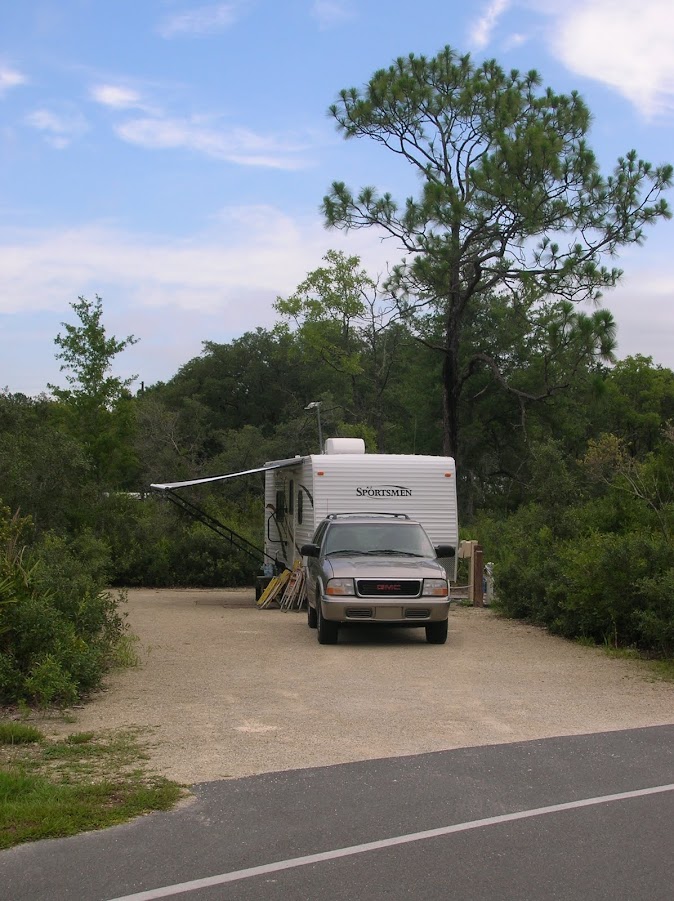
I picked a campsite I liked at Anastasia State Park, in St. Augustine, Florida, while browsing the on-line reservation system, and idly went off to ask my wife about our vacation schedule. By the time I returned to the PC to confirm the reservation, the site I wanted had been snapped up by someone else! I needed a five day window for our camping excursion, and only a few sites were open for five days in a row that particular week in August. I grabbed the next open site and we made plans to head back to our favorite campground in the Florida Park system. We were doing a doubleheader camping vacation, spending time at a park that was new to us at Wekiwa Springs, and finishing the vacation sitting on the white, pristine Atlantic beach of Anastasia State Park.


We arrived on a Friday afternoon after spending a wonderful week at Wekiwa Springs State Park, some 95 miles south. We always travel back roads when possible, and the trip up using FL 44 and Florida Highway 11 from Deland to Bunnell had been a really pretty, uncomplicated drive on a great road. Florida's state and county roads are really a treasure most motorists don't enjoy.  The drive from Deland to Bunnell is especially nice.

It didn't take long to understand why we had a problem getting reservations at Anastasia. The adjacent St. Augustine Amphitheater was having a concert headlined by Alison Krauss and Grand Union Station that very Friday night and many concert goers had brought their campers and tents to be conveniently located just a few hundred yards from the concert site. 

St. Augustine Amphitheater, adjacent to Anastasia State Park


Hint number 1: If you want a camping space on a Friday during a concert, make reservations early. Hint number 2: Check the on-line website for the St. Augustine Amphitheater schedule, and if you find a show you like, incorporate it into your camping stay. The service gate between the park and the Amphitheater is usually open, but it may be closed for performances, so if you plan on using the state park, be sure to check with the Amphitheater when buying your tickets! Duran Duran will be there in October, but they aren't on my must-see list.

While most of our camping neighbors walked through the woods to get to the concert, Ilse and I went down to the dark, almost deserted beach and listened to the concert of the pounding, heavy surf. We got back to our trailer just as the concert goers were emerging from the woods. We all had a good time.


A dead Red Bay tree stands among the dense foliage of the park


Anastasia offers 139 camping sites on five separate loops, several of which are for smaller RVs and trailers only. Most of the sites are level, and almost all are in full shade. However, several sites have quirks that can be aggravating, such as trees that grow in the middle or edge of the campsite that prevent use of awnings, or even keep you from backing fully into the campsite. Most, however, are really great sites. Only two we know of aren't level in the entire campground, and even they can be compensated for with judicious maneuvering of your RV.

One of the odd items this trip were the number of dead Red Bay trees, killed by an attack of Ambrosia Beetles.  The infestations, first seen in nearby Duval County only five years ago, have devastated the plentiful Bay trees of the Anastasia State Park.  State parks have restrictions on bringing firewood that may carry infestations from other locations to prevent introduction of diseases, but the Red Bay trees have succumbed to the pest beetle throughout the park.  None of the other trees have been affected, so the canopy of the dense woods prevails throughout the park even with the numerous dead Bay trees.  


The beach is one of the finest I've seen, and there is plenty of it! The nearby walking trail through the old ancient dunes is a pleasant 30 minute walk, and bicycling at Anastasia is a great way to get around! The kayak and sailing concession at the inlet offers rentals to those who don't bring their own boats. We have used our own kayaks here in the past, and find that this is one of the few State Park locations that allows private owners easy access to the water. Another reason we like this park.


We were impressed the first time we were here, and the second visit simply confirms our opinion: Anastasia State Park is a camping destination we will visit again. We had the unexpected pleasure of a beautiful Florida full moon the first time we were here. Walking through the park to the beach at midnight was a beautiful, almost dreamlike experience. 

I'd like to schedule another visit during a full moon of Fall.  Or maybe even during the winter with the cold, Atlantic air blowing over the sand dunes.  A neat place.


More information about Anastasia can be found at:
https://www.floridastateparks.org/park/anastasia


Next:  A change to one of our favorites, at Stephen Foster Cultural Center State Park, at:


Tuesday, August 23, 2011

Wekiwa Springs State Park

Is there anything else I can you help with?” the pleasant Florida State Ranger asked as he handed our camping park pass and informational brochures through the car window at the entrance to Wekiwa Springs State Park, not far from Orlando, Florida.

“Why are there two spellings for the area around here?” I asked. “Sometimes we see it spelled with a “w,” like here in Wekiwa Springs State Park, but we have also seen it written Wekiva in other places, even just outside the gate. What's the difference?”

“Both are Creek Indian words,” he answered with a big smile. “Wekiwa means bubbling water, and Wekiva means flowing water, so Wekiwa is the spring, and the river the springs feed is the Wekiva River.” 

 
A flock of wild turkeys wander by the edge of the campground


So, now we know why the different spellings for an area we like as well as any in Florida. The state park is located on 7,800 acres just north of a huge urban area that includes greater Orlando. It is actually just north of Apopka, Florida. Once you enter the park, however, civilization is left behind. You even get a lecture at the gate about the do's and don'ts about Florida's Black Bears.

We drove in slowly, and had only traveled a few hundred yards when two wild turkeys took their time and strolled across the road right in front of the car. Our golden retriever, Taz, his head hanging out of the car window, thought he had died and gone to heaven. The turkeys cautiously eyed exuberant Taz and slowly wandered off into the underbrush. Later, while walking the dogs one morning, we had a flock of twelve turkeys walk through the campground.

A ranger stopped by told us to move our screen room completely onto the camp pad.


We found our shady, reserved camp site and backed in with no problem. The camp roads are all paved, with plenty of room to maneuver. There are two camping loops with a total of 60 individual camp sites. Each loop has a modern, clean shower and toilet facility in its center. The campgrounds are shaded, well spaced, and level, with water and 30 amp electrical service. Each site also has a fire ring and a picnic table. We were informed the campgrounds will be closed for almost a year beginning in October as a major upgrade is made to the facilities. Sewer hookups will be added to each campsite, removing the dump-station and its associated septic system. Check with the park before planning any camping as the schedule appears to be tenuous at best. The park and the springs themselves will be open to the public while the upgrade to the campground are being made. Wekiwa is already better than most of the other five campgrounds we've been to this year. I'm sure Wekiwa will probably be great when they finish.

Sand Lake


Wekiwa Springs State Park draws huge crowds on weekends, as do all of Florida's spring-based state parks, so we scheduled our arrival on a Monday morning, long after the weekend crowds have left. In fact, they close the park after all the parking spaces at the spring are full, so if you are trying to get in with an RV on a busy weekend or holiday, you may have a long wait on traffic just to get in. The campground had only a smattering of RVs on Monday when we arrived, with quite a few tent campers, mostly with small, school age children. One last camping fling before school starts for most of them.

Trail to Sand Lake


Our first morning was quiet and hot as always in Florida in August, but with low humidity and a nice breeze. Ilse and I took a leisurely bicycle ride on the shady two-lane park road to Sand Lake. We walked around the small, pretty lake as a nice quiet interlude. We were struck by the silence. No birds, no wildlife at all. A really odd experience for mid-August Florida. We saw a single Gopher Tortoise, and that was it. The lake is ringed with picnic tables and grills, and, unfortunately, cans and bottles left over from the careless few who leave it to someone else to haul out their trash.

The park offers walking trails as long as 15 miles. The trails are well maintained and well marked. On our first forest walk we startled a small herd of deer which scattered through the underbrush. While almost all of the trails are wide, the trails through the sand hill underbrush overgrow the walking area so chigger protection is a must.


The highlight of the park, however, is the beautiful spring. The basin wall was concreted in years ago, making the border of the spring into walkways and staircases to the clear, 72 degree water. The actual spring fissure is only feet from the main retaining wall and the rush of clear, flowing spring water can easily be seen from just a few feet away. The basin itself is shallow enough in spots to allow wading, but wet-shoes are recommended because of the rocky bottom. The swimming area is separated from the downstream river by a wooden pedestrian bridge that was being rebuilt while we were there. The concession that rents canoes and kayaks is just a few yards below the foot bridge. While you may bring your own boats, you must unload in the parking lot and transport everything down a footpath to the launch area, which is cumbersome and not really meant to be attractive to kayak owners. The busy concession stand is obviously meant to make renting a boat a far more attractive proposition than lugging your own. 

Wekiva River


While we were talking to the young man who was taking a break from hustling with kayak paddles and life jackets to the constant stream of paddlers, we noticed two aluminum Grumman canoes tied up at the bank with turtles in them. Not just a few common cooters, but quite a collection of different turtles, all taken from the river and spring area. Several young men and women were taking a break nearby, stripping off scuba gear and wet suits. One heavily tattooed young man in a soggy tee-shirt and swimsuit came over and began chatting with us when I pointed at a small soft-shell snapper that was crawling along the bottom of one canoe. When I called another one a mud turtle, he grinned and said, “Well, yes, but it is actually a variation of a musk turtle.”


They were with the Central Florida Fresh Water Turtle Association, a volunteer group started by Penn State several years ago to monitor the health and population of turtles found in the fresh waters of Florida. He thoroughly enjoyed picking up the different species and showing them to us, explaining how the turtles were numbered and tagged. When I asked if he had any real snapping turtles, he grinned and pulled two big cooters out of the way to show a full size common snapping turtle that obviously didn't want to be in the canoe. Given enough time, I have no doubt he could have chewed his way out. He wouldn't have to, of course. After tagging, all the turtles were released back into the Wekiva River.


The Wekiwa Springs State Park offers us all we look for in a campground and park. Plenty of walking and hiking trails, a nice paved park road for biking, a beautiful spring and river, and a really nice campground. In addition, the nearest grocery store, in case you have to make a milk run, is just several miles outside the main gate.

This park gets five stars from us, and I'm sure after the addition of the sewer hook-ups later this year, it will even be better.


More info about Wekiwa Springs at: https://www.floridastateparks.org/park/Wekiwa-Springs


Next: Back to Anastasia - Another view of one of our favorite campgrounds at:


Thursday, August 11, 2011

Trailer Hitch: Grandma Would Be Proud!

After several months of car shopping and driving all sorts of SUVs that could comfortably haul our new KZ Sportsmen 202, we finally traded our trusty, venerable 1999 GMC Jimmy for a newer, 2005 Toyota Sequoia. We simply wanted more towing power to haul our new 21 foot travel trailer than our six cylinder Jimmy offered. We wanted a comfortable vehicle we could use whenever the travel trailer was sitting dormant, waiting to be once in again connected and hauled somewhere exotic.


We test drove GMC Yukons, Toyota V-8 4-runners, Chevy something or others, and Fords with hoods so high I couldn't see the road in front of me. We drove just about every combination of pick-up truck or SUV that could haul the new trailer and still give us a vehicle we could use “off-duty.” We finally decided on Toyota's big V-8 SUV and drove several Sequoias before finding the dark blue unit we really liked. It only had ninety-five thousand miles on it, and other than a couple of cosmetic issues, was in great mechanical shape. I was surprised to find there were very few used Sequoias with less than 100,000 miles on them.

My dad never kept a car beyond the 60,000 miles. He traded every car before the fenders might fall off or the floor board might rust out, but that was then, and this is now, since Detroit has been slapped up against the side of their corporate heads by foreign competitors. Our American-built, Japanese designed SUV looked like new, except for the floor mats, which we replaced.

I added a new brake controller and was pleasantly surprised to find the necessary wiring was already in place, all I had to do was take off the existing plastic caps from the wiring coiled up under the dashboard and plug in the new controller. Nothing like planning ahead.

I had the Sequoia safety checked and all the inspections brought up to date, from spark plugs to brakes. When we test drove the SUV with the trailer attached, we knew we had a great combination. Only one thing needed to be resolved: The ride height difference between the two vehicles. The trailer hitch had to be lowered to keep the travel trailer level.

The two-inch box hitch receiver is fixed on each vehicle, but the shank on the trailer ball assembly for the load equalizer was adjustable. All I had to do was move the shank down and we once again had a level travel trailer. But I had a problem: I didn't have any regular wrenches that even came close to big enough to fit the nut on the hitch.


However, using the Ford wrench from my grandmother, yes, my grandmother, I made the switch effortlessly. You see, my grandmother used to build bombers. B-24 Liberators, to be exact.

B-24 Liberators being assembled at Ford's plant at Willow Run, Michigan
1943 Ford photo from Wikipedia Commons


Laura Corns Mindling, my grandmother, worked during the war for Ford Motor Company at the Willow Run Aircraft Plant, just outside Detroit, Michigan. She was a press operator, and a good one. After the war, Ford kept her on at the River Rouge plant, near Dearborn, where she worked until 1956. She slipped on an oily floor that year and broke her wrist in the fall. When she was finished with her medical leave, she took full retirement, and eventually moved to Miami, living with her husband Lou, first with us for several years, then moving not far away in their own efficiency apartment.

Assembly line at Willow Run, 1943
 Any of the women could have been my grandmother, Laura,
who worked as a drill press operator for Ford until 1956.
Wikipedia Photo


Laura lived alone for several years in Miami after Louis, my grandfather, died, then moved to live the rest of her life with my Aunt Ruth in Denver. After Laura's death, my brother and I received several artifacts and family mementos. I received a few items, including a heavy, wrapped bag.

Included were two wrenches used by my Grandmother at Ford, oh so many years ago. I like to think she used these tools to help win a war, or build a car that perhaps someone she knew may have driven. At any rate, today, those wrenches helped me change out a ball hitch and a trailer shank that had me absolutely stumped. Grandma would have been proud.

Next: On to Wekiwa Springs State Park, right in Mickey's backyard, at:


Tuesday, July 19, 2011

O'Leno State Park


The 1934 suspension bridge over the Santa Fe River at O'Leno State Park


When I turned off the paved main park road onto the entrance to the Dogwood camping loop, my first reaction was, “Whoops, I must have missed the turn somewhere!” Nope, both of the camping loop roads, both Dogwood and Magnolia, are not only narrow one-way, single lane dirt roads, but it has been a long, long time since they have seen a grader. Ragged is the first word that comes to mind. The ruts in the first few hundred yards did not make the rest of the loop seem inviting. Nevertheless, we pulled into the heavily-forested campground and checked our reserved site, number 32, with some dismay. It is the very first site of the loop, and at the very bottom of a gently sloped hill. Not wanting a repeat of sloshing through puddles as we had done at Rainbow Springs, we called the park office and they cordially gave us a list of available, alternate campsites that would be available for our planned four-day stay. The Internet map, by the way, is only a vague resemblance to the actual campground. Well, the map's loop is round, sort of.

The Dogwood Camping Loop

We checked the next two sites and picked site 34, a shady site at the top of the small hill. A quick cell phone call to the office and we were all set. Our next revelation was there is no vehicle access to the shower/restroom facilities to the Dogwood loop. The only road is an access road for service vehicles only, adjacent to the camp host's site. The toilets are land-locked, so to speak, with only barren, narrow, and very rocky foot paths that lead from the back of each site to a main path that precariously meanders to the bathhouse. Stumbling along the rocky, and sometimes mossy, path to get to the toilet is the hard part: the facilities are fairly new and spotlessly clean.  There is a covered trash can station at facility as the main dumpster, as is the dump station, is a mile and a half away at the Magnolia campground. The shower and toilet facilities at the Magnolia loop are not only drive up accessible, there is room for several vehicles at once.

Almost all of the sites we looked at are full shade, with water and 30 and 50 amp electrical service, on packed sand, and all appeared fairly level. It only took us 30 minutes or so to be completely set up. Larger campers or longer trailers might have a problem backing in to some of the sites as there is little room to maneuver as you back into the 90 degree sites from the single-lane, dirt road. 

Campsite 34 on the Dogwood Loop


The rocky, moss covered path to the restroom/showers


We didn't do our traditional spaghetti dinner. Instead, we broke out the shrimp and the cocktail sauce along with a couple of glasses of wine, and relaxed after an almost 5 hour drive up from Port Charlotte. We broke our usual travel rule and traveled up I-75 almost the entire trip. My nerves were frazzled, as they always are when I have to share the road with a two-ton missiles operating at speeds above 90 feet a second by operators who can't see my big, white, 20 foot trailer! I'm firmly convinced many of them can't see each other, as well. I'll take my back roads any day!

The campground was almost 4 degrees cooler than the road coming in. With a nice breeze, it was really a beautiful July day in Florida, just barely over 90 degrees. We took a drive over to the other campground, the Magnolia loop, and watched a doe and her fawn alongside the nice shady main park road, and then took Taz and Daisy on a mile and a half walk around the Sante Fe River sink. The river actually goes under ground here, and pops up again some three and a half miles south at the Sante Fe River Rise.


The trails are well maintained and marked, and they have trails for every type of hiker.  Bicycles are allowed on only some trails, you need to check the park brochures for details, but pets are allowed on all trails. By the time we finished the “Yellow” trail, Daisy and Taz were exhausted from the heat and humidity, even though we were protected in the shaded forest. Again, take precautions against ticks and chiggers by spraying your shoes and legs with insect repellent, (spray everything!)  especially in the summer season.  We had a problem with chiggers here that we hadn't had anywhere else, but, in all fairness, we spent quite a lot of time walking the beautiful trails with our two dogs and we failed to spray ourselves before we walked.  Checking for ticks after walking the forest paths and trails is mandatory. 

[For more information on Chiggers, see my link at :
http://sleepstwo.blogspot.com/2013/08/the-dark-side.html]


The park is one of the oldest in Florida, and is actually built on the old Florida town of O'Leno, which we were told is pronounced “O'Leeno” Why, you ask? Because the original name of the town was Keno, named after the card game. Church and Civic pressures were applied in the middle 1860's and the name was changed. But, apparently, not the pronunciation.

It is a beautiful, unique park, with a thick forest covering the entire park. The proximity of I-75, however, might be a draw back during the months when you don't have your A/C on if you stay at the Magnolia loop campground. Highway traffic noise can be clearly heard from the Magnolia campground, but not from the Dogwood Campsite, which is further away from the Interstate.

This is a nice campground, and even a better park. It is a great place to use as a base to check out central north Florida. There are more springs near here than I can list, including at least three local “Blue Springs.” The sandy sites might be a drawback to some, but the sites are hard packed and no problem.


The Sante Fe river was very, very low due to the lack of rain, and not at its prettiest.  The swimming area was temporarily closed due to lack of water.  The river is fed off of the upper Suwanee River, and when that river is low, so is the Sante Fe. Still, the old suspension foot bridge, built in 1934 by the CCC, the Civilian Conservation Corps, is unique, as is the history of a town that time has long since vanished and been forgotten.

On Sunday, we drove out of the park and headed south along U.S. 441, looking for the Santa Fe River rise, and eventually found a county canoe ramp near the spot the river crosses under the highway. We took photos of the pretty stretch of river and watched the many wading birds that were taking advantage of the low water level. A woman soon walked up with an older Black Labrador on a leash, and we began chatting about the area. As we talked, the Lab, named Sheba, pulled toward the shallow river, so her owner, Ann, unleashed her. Sheba slowly waded out into the river and laid down.

Sheba cools off just before meeting a canoe


Ann and her husband are transplants from Sugarloaf Key, and have lived in the area for over ten years. We had a pleasant time talking about the pros and cons of living this far north versus living in Miami and the Florida keys. while we chatted, Sheba stood up and waded further out into the river between several large rocks that protruded out of the gently flowing river, and laid back down in the water. Sheba was facing downstream with the water running past her hips.  She was as happy as any Black Lab can be.  Soon, an aluminum canoe came slowly paddling downstream with three young people leisurely enjoying the quiet river. The young woman in front paddled, as well as the young man in the rear, but the woman in the middle was just looking around, enjoying the ride.  As they passed by the remnants of the old highway buttress right in front of us, they ran aground with a loud crunch. 

The girl in front saw Sheba and called back to us laughingly, “Have the dog give us a push!” 

The girl in the middle had been looking over the other side of the canoe and did not see Sheba, who stood up just as the girl turned her head to look at us.  I have no idea what the girl thought, but by the look on her face it must have been a real shock to see a huge, black animal rise up out of the  river and look at her at eye level from only a few feet away! Sheba just watched as the trio finally got out of the canoe and pushed through.

We said goodbye to Ann and Sheba, and drove down to High Springs just a mile away to continue exploring this part of Florida.

The O'Leno campground is quiet, offering very good privacy and space between most campsites. Both campgrounds are completely covered with a beautiful hardwood forest. The Magnolia campground is adjacent to the river sink, along with the swimming facilities, which were closed while we were there due to lack of water, and adjacent to the permanent facilities of the park. There is no gift shop at the park. Limited items such as caps or shirts are available at the ranger station when you drive in.
The Sante Fe River rises some 3.5 miles away and continues its journey south


More information about the park can be found at:
https://www.floridastateparks.org/park/Oleno


Next: A new tow vehicle and my grandmother's wrenches, at:


Wednesday, June 29, 2011

Rainbow Springs State Park


Rainbow River


As we approached the intersection of State Road 484 in Dunnellon, Florida, headed north on US 41, I spotted the discrete, low mounted camper icon arrow pointing to the right out of the corner of my eye. The main road sign for Rainbow Springs State Park points straight ahead, but the almost unnoticeable white image of a camper on a brown background mounted below the main sign post has an arrow pointing to the right instead. 

Rainbow River


We thought, “How cool! They actually had the foresight to warn campers the campgrounds for the State Park are on the other side of the Rainbow River from the main park.” In fact, the two parts of the park are about seven miles apart by the shortest route.

However, after turning on to state road 484 and driving for fifteen minutes without seeing any further signs, we began to question if we had indeed misread the first sign. We diligently checked every intersection, looking for the next sign pointing to the campground. It was raining, and we were extremely cautious not to miss the turn-off sign.

The rental canoe rack at the head-spring.

When we crossed State Road 200, some 9 or 10 miles from U.S. 41 without seeing any signs for the State Park, we were not happy. We pulled off at a wide spot of the road and checked the GPS, which takes you to the main park at the head-springs on the wrong side of the river, not the campground. 

The GPS map showed a possible access road, 180th Ave, which proved to be the right road to the campground. A U-turn towing a travel trailer is always a pain in the butt, especially on a two lane road, and State Road 484 is no different!

The Rainbow Springs State Park campground is not marked from either direction from SR 484!1 There is no indication of the state park campground entrance anywhere on the State Road. Too make matters worse, when I finally pulled into the State Park entrance on 180th Avenue in a driving rain storm, I was informed the entrance I had entered is for tubers only. The campground entrance is another two miles up the road. I might as well had gone tubing, by the time I had sloshed over to the office and back, I was wet enough.

The walking trail at the campsite


Site 25 at Rainbow Springs State Park


After another U-turn to get out of the tubing entrance, I pulled back onto 180th Ave and continued on for another two miles or so. When I pulled into Rainbow Springs State Park Campground, I wondered where the guard house, or welcome shack, was located. 

There is a swing arm gate that closes at sundown across the two-lane road, but no ranger station. The first thing we encountered is a strangely laid out tarmac with a dump station on the far left side. It was still raining heavily when we arrived so the only thing we could see was what appeared to be a huge parking lot and a gift store. That's it! After walking to the gift shop, which indeed is where we registered and got our windshield pass, I squished back to the truck and looked up our reserved site, trying not to get the map wet. It was almost a quarter to 4:00 pm by the time we registered. We had wasted almost an hour because of the missing sign on SR 484.

Ilse at the Main Park Overlook


We found our site, number 25, just as the rain began to let up. Ilse didn't get too wet as she backed me into the slot, which was completely under water. She held our little Motorola Walkabout radio in one hand and her collapsible umbrella in the other as she tip-toed through the huge puddle, giving me directions and making sure I didn't knock down the electrical box on the side of the campsite.

We sat in the car for a few minutes as the little flood subsided from the almost perfectly level campsite. She laughed as she told me about the site which was listed as partial shade. There is one scrawny, pine tree and that's all. Recently graveled, it was soon ready to walk on without getting our shoes sopping wet. We were completely un-hooked and set up in about 30 minutes. 

A full service campground, the fairly new campground has water, 30 and 50 amp electrical service as well as a sewer hook-up. The sites are rather sparse as far as vegetation is concerned, with only a few sites offering any shade. Privacy isn't bad, depending on the site location, but there are several completely in the open. I would avoid the first few sites on either loop at all costs as they sit in the middle of the pull-in loops, and have no privacy what-so-ever.


The restroom/shower facilities are new and absolutely spotless. Not the same can be said for the area around the office/gift-shop, which is in dire need of tender loving care. The closed swimming pool at the rear of the office has weeds growing around the perimeter, as in fact, does most of the campground.3 Dog Fennel, a tall but unattractive native Florida weed that is always the first plant to grow back after a fire, is everywhere. A good mowing is in order, but that is an issue that probably has been whacked by the recent budget cuts.

After breaking out the shrimp and the cocktail sauce, which served as a great appetizer, we had our traditional first dinner, spaghetti. Then we took a stroll to one of the prettiest, clear rivers in Florida, the Rainbow River, just a few hundred yards beyond the office/gift-shop. The evening air was cool, clear and mosquito free. A pleasant, Florida stroll.

There is a small swimming area here, and an aluminum ramp used to launch both paddlers and tubers who flow downstream two miles to the takeout point at the first park entrance. The park runs a tram for tubers between the two locations downstream from the head-spring. The main area at the head-spring seven miles away has a much bigger swimming area and many more canoes and kayaks for rent. 

You are given two windshield passes when you check in. The one is for your windshield at the campground and the other is for the main park entrance at the head-spring which normally costs two dollars.

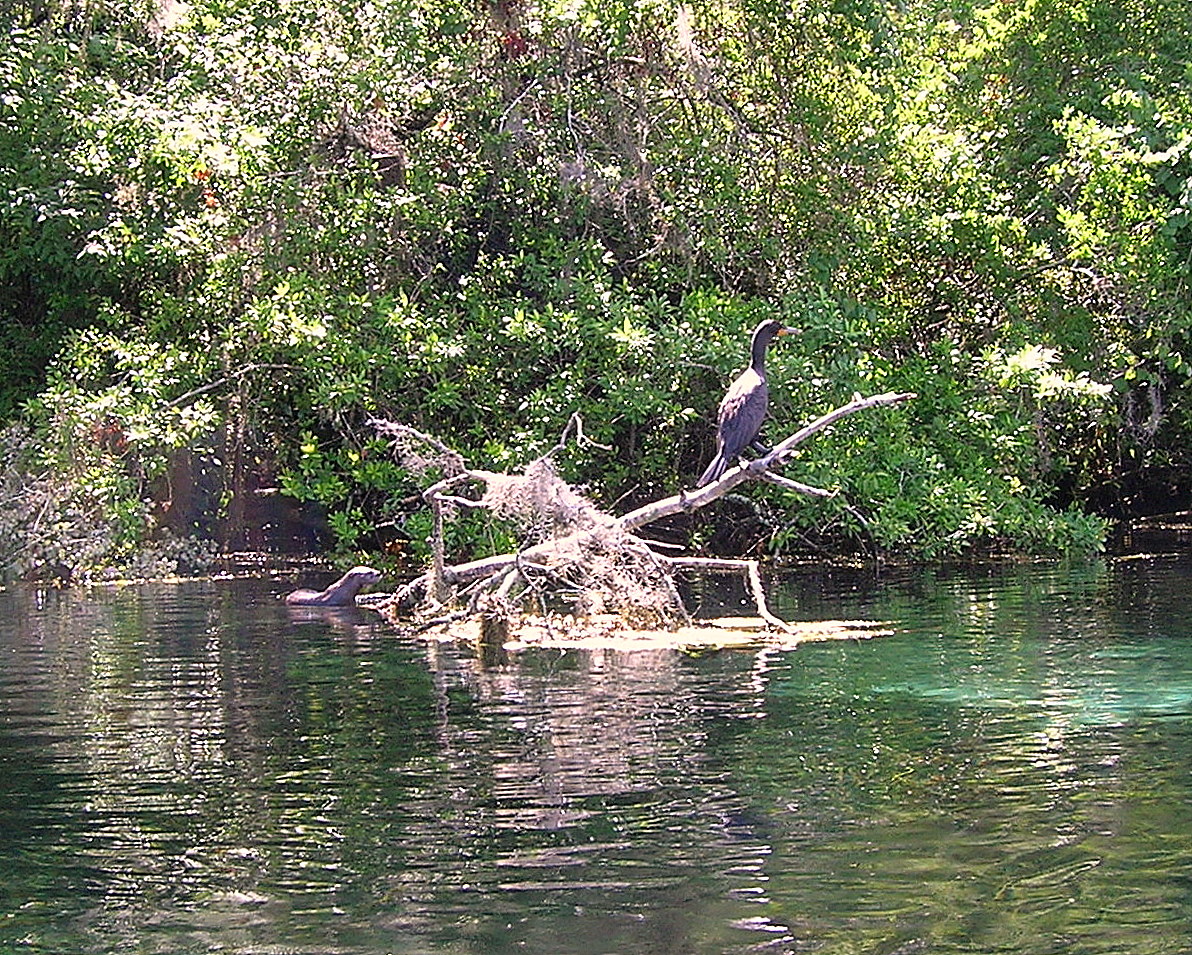
An otter climbs up a tree branch while a cormorant watches warily


The park at the main head-spring is one of the prettiest parks in the Florida park system.  A former Florida tourist attraction that went bankrupt in the middle seventies, a victim to both I-75 and the then newly-opened Disney World in Orlando, most of the attraction's beauty has luckily been saved. Closed for several years due to litigation and legal wrangling, the State of Florida eventually opened the head-spring area to all visitors.

Getting to the main park from the campground on the other side of the river requires a car, or bravery, if you are a cyclist. The short route, north to County Road 40 is around seven miles long. Riders must share the road with motorist doing 55 mph on both county roads as well as U.S. 41 as there is no bike trail or bike lane. The southern route is almost four miles longer, and just as dangerous. The main park, however, is a park not to be missed.

The walk from the parking lot to the entrance is a taste of the beauty of the park. Once inside the park you have two choices: To the right leads downhill to the swimming and paddling area, the other side to the once commercially-maintained gardens and forest. The head-spring area for swimmers and paddlers who flock to the 72 degree spring, especially on weekends, is very popular. I highly recommend visiting during the week, if at all possible. The forest trail has a low, wide paved path to the waterfalls, and a higher return path back to the gift shop. The gift shop, incidentally, doesn't open until 11:30am, and closes again at 4:30pm, so don't count on buying batteries if you get there too early.

Man-made waterfalls and cascades have been preserved as well as the foliage that dominates the area. The walking path leads to the Butterfly garden, and if you are lucky, you'll get to meet Charley, the volunteer who almost single-handedly maintains the beautiful area, and get to chat with someone who really knows his plants. The other side of the butterfly garden leads to several walking trails, one of them three miles long.
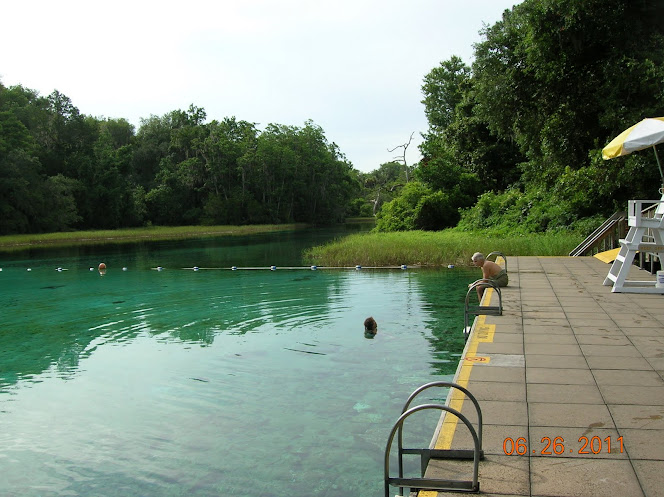

Swimming area at the Main park


The swimming side of the spring has a dock for swimmers, and a few hundred feet further downstream, a rental facility that has 20 Grumman aluminum canoes and 12 two-man Pamlico kayaks which can be rented for $10.00 an hour, with a two hour minimum. There can be a waiting list for rentals on weekends.  Years ago, glass bottomed boats took tourists for short, twenty minute excursions down the river, pointing out individual springs and hiding places for the Large Mouth Black Bass that helped make the river famous.

On Tuesday morning, we parked our Jimmy in the lot in front of  the gift shop at the campground location and walked the short distance to the river put-in ramp.  Luckily, we met the driver of the tram from the tube rental part of the park, the entrance gate we had erroneously pulled into during the rainstorm. On weekends, the concession has a full-time person on site all day, but during the week, you have to catch the driver of the tram as he has the keys to the boat rack and the required paperwork. The tram appears every half hour or so. After signing a waiver, leaving your driver's license with the tram driver, and paying your $20.00, you get to push off into one of Florida's prettiest, clearest rivers.

The water flow is consistent, but not overwhelming, as you paddle toward the head spring. The paddle is an easy 40 to 45 minute trip, with houses on one side of the river and wild forest on the other. About half way up the river, we met an otter which theatrically climbed up on a log for us so I could take a quick photograph. A Cormorant sitting further up the tree log watched apprehensively. Several children in a canoe started yelling about the otter and it immediately slipped quietly back into the river. We never saw it again.

The river is absolutely clear and every bass, bream, anhinga, turtle, or even cormorant, that swims anywhere near your boat is clearly visible. The absolutely crystal clear water is 72 degrees, and after a few minutes the water is actually comfortable enough to drag your hand or foot as you take a break from the leisurely paddle. We met many kayakers headed toward us from the head-spring area, with a few typically unconscious paddlers who probably drive their cars with the same total disregard for others as when they paddle.  Don't expect other paddlers to know what they are doing.  I HIGHLY recommend paddling on the river during the week rather than on weekends. We were told by the tram driver the past weekend traffic jam had backed up the county road leading to the park with tubers and paddlers. I can see why, this one of the nicest paddles we've done in along time.


This park rates as a “will come back,” one of the prettier parks in Florida.

More information about the Rainbow Springs State Park can be found at the official web site at:
https://www.floridastateparks.org/park/Rainbow-Springs

1 According to park rangers, the original campground markers at SR 484 were removed during road improvements by Marion County. At the completion of the road work, Marion county tried to charge the Florida State Park system $1200 to remount the signs, the Florida park system rejected the bill and the signs have never been remounted!
 
3 The $18,000 required for repairs was stricken from the State Park Budget by the 2011 Florida legislature.


Next Up: Oleno State Park at:


Featured Post

The Waterfalls Trail

After several days of hiking and walking shorter trails to build up our stamina, we decided today was the day to descend the Waterfall T...