Saturday, August 29, 2015

The Last Train to Clarksville


BRSR Depot - Blue Ridge, Georgia

The image of stepping up into an old railway coach and through an imaginary portal into years gone by sells as many tickets for the Blue Ridge Scenic Railroad as does the allure of a scenic railroad trip through the north Georgia mountains. The popular heritage railroad runs as much on nostalgia as it does on sightseeing. It does not run on commerce, although local commerce has much to do with the success of the railroad as it has become an integral part of the tourist appeal of the area. The old rail service to the heart of the Copper Basin, back when the track was part of the Marietta and North Georgia line, has evolved into a specialized, smartly run opportunity for old-timers to tell their grandchildren what it was like in the old days.


The trip begins at the depot in the heart of the smart, upscale tourist-oriented town of Blue Ridge, Georgia, and ends an hour or so later in a unique destination just twenty miles away on the Georgia/Tennessee state line. When the freshly painted blue and yellow, ten-car train finally and slowly screeches to a stop, it has its front half in Tennessee and the back half still in Georgia.

Passengers are treated to a very pretty ride along the Toccoa River as it runs north – yes, just like the St. Johns – into Tennessee where the name of the river changes to the Ocoee River. The town of McCaysville, Georgia/Copperhill, Tennessee, the destination of the nostalgia-induced journey, is where the train stops and passengers disembark for a two hour visit before the return trip to Blue Ridge.


There is really only one town, delineated by a series of rectangular blue dashes painted on sidewalks and on the streets, and you may not be aware of which town you're in as you wander around looking for a restaurant or a souvenir to take to the friends back home. Many of the passengers from the train have their heads buried in the brochures handed out by local merchants who greeted them as they disembarked from 


The Blue State Line at McCaysville, Georgia/Copperhill, Tennessee

the train and don't see the fading painted marks on the sidewalks. I couldn't help but think of cruise ships that flood small, coastal communities from Jamaica to Alaska with sightseers and tourists, then depart with everyone back on board, leaving nothing behind but cash and credit card charges. Except here they depart by train. When it's full, as many as five hundred passengers shuffle back to the waiting train when they hear the warning horn. Don't miss the four blasts on the train's horn, the ten minute warning, or you take a taxi back to Blue Ridge.   

Toccoa River

The Toccoa River is not the wild and scenic river envisioned by tourists who rely on television or multimedia advertising for their understanding of the world outside of their daily lives, but it is a testament to what we can achieve when we want to. The upscale homes that dot the banks of the clear, light green-colored, steady flowing water aren't the rustic, Appalachian leftovers from the defunct copper mines that give the Toccoa River its distinct color. Visions of pioneer outposts soon give way to parked Mercedes sedans and four-wheel drive pickup trucks. This area has been discovered by realtors and summer residents as well. The river is very popular with tubers, kayakers and white water rafters as the 1996 Olympic whitewater sports competition events were held just a few miles downstream from Copperhill. This is also the trout fishing capital of Georgia.

The 500 year-old fish trap on the Toccoa River


 One of the artifacts pointed out by the guides on the train as it slows to allow photographs is a Native American fish trap thought to be over 500 years old. The fish trap, created by carefully placing large stones and rocks to form a river-wide sluice that funnels the water flow to a central collection point, is directly in front of a newly built river-front home. The thought of tribes that preceded the Cherokees living and fishing where someone now parks their Lexus triggers my imagination and awe. I would have a hard time mowing the lawn here without thinking about what happened on the banks of the river so many centuries ago. The Toccoa River is still a beautiful river, and most property owners do much to keep it pristine or clean. It is a very pretty ride through a very unique part of Georgia.


McCaysville, Georgia/Coppertown, Tennessee - Beauty is in the eye of the beholder.

 The friendly BRSR staff asks everyone as they re-board the train which side they sat on during the trip down, – the trip may have been north, but you went downhill – then has them sit on the opposite side for the return trip to Blue Ridge. Everyone gets to see both sides of the excursion. The railroad even has a properly dressed conductor who walks through the train, chatting with everyone and punching tickets just like in years gone by. In reality, if you have a color-coded sticker with your assigned car number on your lapel your ticket has already been verified, but it is a nice touch for all the old-timers and dreamers who like to think they've taken a step backwards through time. While the whole journey takes four hours, the trip back lasts seems to last for only forty-five minutes or so, or is it just my interpretation of the return trip – they always seem shorter – and before we know it, we are back in Blue Ridge with plenty of time to stroll around and look at shops.


The train runs Fridays, Saturdays, Sundays, and sometimes Mondays, depending on the season, and is incredibly popular during the autumn months when the mountain foliage turns red and yellow. The train runs daily during the month of October, and twice daily during fall weekends. The Blue Ridge Scenic Railroad shuts down after the first of each year and but starts again each spring, so check their website at brscenic.com for schedules. Yes, we'll do it again next year.  


NEXT: Helen, Georgia - A closer look, at:


Sunday, August 23, 2015

Vogel State park - Pouring In

Pouring in. Not the rain, the campers. It's Thursday evening and the beat-the-weekend-crowd crowd - no, that is not a typo-  is pouring in. It's raining again as well, – it's rained every day since we got here on Monday – but the stream of campers is more impressive than the water flowing down the middle of the loop road. RV's of every shape and size pull through the loops of Vogel State Park looking for the best possible camp site. The bigger units like the Class A and larger Class C's have to drop their towed cars before entering the shire, sorry, the campground, and those campers use the smaller vehicles to reconnoiter the camping loops while the mother-ships wait behind patiently. I would imagine it's hard to distinguish camp sites in the rain but many of the campers are repeat visitors and know exactly which of the 68 sites they are looking for. The weekend crowd is going to be disappointed they didn't get here earlier.


Vogel has somewhere around 300,000 visitors a year, but how many are campers and how many rent one of the 33 cabins isn't clear, but after spending four days here, almost solid rain not-withstanding, we see why this park is so popular with RVers. This loop filled up quickly and many RV's make the cul-de-sac turn at the end of the road and head back past us hoping the remaining available sites aren't the worst ones in the park. We retire to the trailer and fix dinner when the rains once again start and darkness slowly falls on the campground. A few late arrivals still drive through searching for open sites.
___
Hungry tree attacks slow moving rock...

Friday morning breaks dry and cool and several campers up the road from us who were here when we arrived, break camp and head out, probably to avoid the weekend crush. Ilse and I decide to explore one of the trails at the end of our loop while walking Taz, our Golden Retriever, and take an excursion into the woods on a well-worn path that isn't well marked. The recent rains have left their mark on the trails as the paths are well rutted. We follow a trail that wanders around the base of Blood Mountain, then drops back into the campground about a mile a way. Great hiking trails here, and we'll do this one again on Monday after the crowd heads home.

Most of the newly vacated sites are soon occupied by new arrivals as very few sites remain open for long. A steady stream of campers towing trailers make the futile trip looking for sites.

Soon, a throng of onlookers watch as Don and Wendy struggle through the campground with their 42 foot long, three axle trailer looking for an open site, and after making the excruciatingly tight turn at the end of the loop, finally back into the last remaining site on our loop just below the camp shower facility. There isn't any free space left on their campsite after they get settled; the front bumper of his pickup truck is right against the roadway. The Vogel campground dates from the 1930's when trailers and campers were smaller, and while some of the sites are suitable for newer, bigger units, the roads and bridges are confined and narrow by most modern, commercial campground standards. There isn't much clearance on many of the tight turns and curves. Still, they are happy to be here, and plan on enjoying the coming weekend.

In a case of irony that couldn't be scripted, Don and Wendy have to park next to an eighteen foot long Casita, one of the smallest travel trailers on the market and definitely the smallest camper in the campground. Our dear friends Richard and Arlene, who got us interested in camping in the first place, also have a Casita, so I had to take one of those comparison photos of the two units side by side. Two different views on Rving, and each has its own merits.

An 18 foot Casita is dwarfed by a 42 foot Fuzion - Each has its merits...  and drawbacks


Good weather is forecast for the weekend and we are supposed to get a break from the rain. There's live music scheduled by the lakefront tomorrow evening, all we have to do is bring lawn chairs. School started in Georgia two weeks ago, so most of the campers here during the week are older, mostly retired couples, almost always with their pets. Weekend campers usually are younger, working people with kids, but there are few children here so far. The campfires all smell like hickory, and the only water we hear is from the creek behind us. All in all, life is good in the shire.

___
Saturday morning is when the park staff earn every penny they're paid. The weekend warriors are here in force and every conceivable question about the park or situation that requires immediate attention takes place now. We walk down to the visitors center to pick up a hiking trail map and watch in horror as an elderly fellow backs up in the parking lot, after looking as best he could, into a family with young children and a dog on a leash that wander unconsciously behind his car. No one is hurt, but we are reminded why we like empty campgrounds.
Lord of the Rings, anyone?

People are standing in the visitor center elbow to elbow. The weekend crowds are here, enjoying the lake and the hiking trails. Almost everyone seems to have a dog, but they are all leashed, and so far, well behaved. The kids aren't leashed, but for the most part, they're having a good time and except for an occasional pack of young bicycle riders frantically pedaling past, you wouldn't notice. For a full campground, it is relatively peaceful.

Ilse and I walk around the small but pretty lake – some would call it a large pond – and walk down the short spillway trail at the far end and are quite taken back by the beautiful waterfall at the bottom of the trail. A woman taking photos from the wooden deck lookout accidentally drops her walking stick into the creek below and her companion dutifully climbs down the rocks to retrieve it for her. He clambers over the rocks and avoids falling in, and successfully retrieves the hiker's aid. Another young woman watching with us on the deck volunteers to take our photo with the waterfall as a backdrop. Our first photo of the trip with the three of us.


The rains hold off for a second day so we decide to take advantage of the good weather and set up our screen room. We take the formidable looking collection of fabric and aluminum poles out of its bag and wonder how did we do it last time? No problem, after unfolding a few legs or arms or what ever, it begins to look like the picture on the outside of the box, and within just a few, trouble-free minutes, it is set up and ready for use. We position the screen room just behind the camper, then set up the gas grill and open another bottle of wine. We sit and watch as the curious crowds wander by, and by early afternoon, we are pretty much left alone. The campground is full but it is relatively quiet up here at our end of the park. Time to grill the chicken and kick back. Ilse is already deep into a book she has been trying to read for several days, and we still have over a week to go. Come Monday we will have the park to ourselves once again. Vogel gets great marks from us, a park we will return to in the future.


NEXT: The Last Train to Clarksville, at:


http://sleepstwo.blogspot.com/2015/08/the-last-train-to-clarksville.html


Wednesday, August 19, 2015

Higher Up - Vogel State Park


After spending a week with our daughter and her family near Athens, Georgia, we resume our 2015 camping trip. We head north to Vogel State Park, near Blairsville, Georgia. This will be our first stay at Vogel, one of Georgia's premier state parks, in the foothills of the Smokey Mountains. We've stayed at nearby Unicoi and Amicalola State Parks in the past and enjoyed not only the parks, but the surrounding mountains as well. We saw our first Black Bear just west of Ellijay while staying at Woodring Branch Campground at Carter's Lake.

We take a round-about detour off the direct route of US 129 at Gainesville, headed west instead of toward Ellijay, not only to avoid the left turn off of northbound highway 129 into the Vogel Sate Park entrance, but also to avoid the climb up the mountain from the south as well. Amicalola State Park, where we stayed several years ago, is just a few miles off our detour route to Ellijay, and it seems there are more Florida, Alabama, and Tennessee license plates on the road than Georgia plates. We enjoy the ride through Blueridge, sharing the highway with the traffic headed north from Atlanta. This is a busy highway, but a stress-free ride. We can't check in until after 3:00 in the afternoon so the trip becomes a sightseeing tour as well. We finally turn off the four-lane, divided highway in Blairsville, not far from the North Carolina state line, circle around the court house and head south on Highway 129 toward Vogel State park. It seems odd as we traveled north on 129 to get to Gainesville. We doubled our mileage instead of driving straight up US 129 from Athens, but the trip was worth it.

It's drizzling when I check in at the Vogel office a little after three in the afternoon on a wet, overcast day, and confirm our seven day reservation. Ilse and Taz sit in the car and wait as I check in. I called the office here a week ago from Stephen Foster State Park at the other end of the state after I tried to make on-line reservations through ReserveAmerica.com but couldn't find a way to apply the 20 percent discount Georgia offers campers over the age of 62. No problem, I was advised by a sweet, Georgia accent, just make the minimum deposit required on line to hold your reservation and the park ranger will apply any discounts when you check in at the desk and pay the balance. I did and it worked perfectly. I ask about campsites on the lake, and Lisa tells me there are no lakefront sites, but some campsites do butt against the creek. A male voice from somewhere in the back office laughs, “If this rain keeps up, they'll all be lake front.” He then adds, “32 and 51 on the creek are open, I was just up there. Just clip your yellow guest card on the post in front of the site you want.”


The Georgia State park system doesn't reserve individual camp sites so it is first come, first served. If they have 50 sites, they take 50 reservations and that's it until someone checks out. The sites are limited by size, though, so you will be assigned a color that corresponds to all the campsites suitable for your unit. Here at Vogel there are only two colors, red and yellow. The red sites are for small, van type campers, or units less than 25 feet in length. The access road to those sites has a warning about the narrow, twisty loop road.

After you check in at the visitor's center, you drive through the campground to find a spot you like – or, as we have found out, which of the few sites are empty – and back your camper in, or if you're lucky, pull through. Theoretically, you should be able to clip your guest card – it has your name and departure date written on it – to any empty spot just in case you have to go around the loop again. When it's busy, you can't be choosey because the guy behind you might pick the site you just passed and you won't get a second chance at it. Kind of like squatter's rights.

By the time I slosh back to the Toyota on the far side of the parking lot, it is pouring. It is coming down in the proverbial buckets. I have no choice but to slowly drive to the dump station as we have full black and gray water tanks from staying at our daughter's place. Not dumping there may help ensure our welcome next time we go back. We have to dump both tanks before we set up the camper, so I dig around in the arm of the Toyota's console for one of the 99 cent polyethylene rain coats I keep for just this type of weather, and after only one tour around the campground, find the dump station and I dutifully empty both trailer holding tanks in the pouring rain. No problem, I haven't had to setup or break camp in the rain since Rays Town Lake several years ago.

We slowly drive past site 32 and decide to pass; it is part of a communal ring of sites and the nearby creek is no benefit as it is on the opposite side of the camper from the camper door and the awning. Probably great for family reunions, but a little too cozy for us. We press on and immediately like site 51; no standing water in the site and it is a little staggered, or tiered, like Unicoi State Park. Ilse dons a poncho and using our little 2-way radios, backs me in to the site without problem. It is the first time I've backed the trailer up completely blind, I couldn't see a thing behind me from the rain and fogged up windows. We retire in just a matter of minutes to the trailer to open a bottle of wine, both still reasonably dry. No reason to get completely soaked, at least not yet.

We wait out the rain, and during a lull, I hook up the electrical and water connections and unhitch the Toyota. Our campground power box is right in front of our site, so we need our 15 amp extension electrical cord to extend our standard power cable, and a second water hose to hook up to the water supply. The box is too far way for the standard length cables and hoses. It is the first time since we stayed at Tioga we've needed either the extra electrical cable or the second water hose. Always nice to have both in case of emergencies.

From what we've seen so far, Vogel State park is a beautiful campground. We've heard nothing but good things about Vogel State Park, one of the oldest state parks in the Georgia system. While cellphone coverage is limited, Wi-Fi is available at the office and no sign-in is required. Hopefully we'll be so busy we won't need it. At just under 2,900 feet high in the mountains, temperatures tends to run a little cooler than just a few miles south of here. It's only 70 degrees as we relax, cook spaghetti and listen to the rain. The whole campground has packed it in for the evening as misty light fades into indistinct shapes and shadows. Rainwater runs down the road and off the camping sites into the creek just behind us. It is peaceful in the shire.


NEXT: Pouring in, at:


http://sleepstwo.blogspot.com/2015/08/pouring-in.html


Monday, August 10, 2015

Billy's Lake and the Stephen Foster State Park, Georgia

We took a quick tour through Fargo - population 321 - before turning around and heading out highway 177 to the Stephen Foster State Park. As we drove through the Slash Pine forest toward the main park gate on route 177, we were happy to see most of the forest recovering from the horrendous fires of 2011 although scars are everywhere. The several roadside ponds are once again filled with water lilies, but we're lucky today as the rains have held off. We are the only vehicle on the seventeen mile road and see only one camper in the state park as we pull in. It turns out to be the Class A camper belonging to the camp hosts.

We check in with the ranger at the temporary trailer being used as a headquarters building and once again select a pull-through camping spot. Every rental boat at the nearby dock is tied up and all the canoes and kayaks are forlornly stacked along the edge of the access slough, waiting for renters who haven't arrived. The park is absolutely empty except for us. Early August is not a real popular time to visit the Georgia swamps, so this definitely isn't peak season. The weather has been ten degrees cooler than at home and quite enjoyable. 

Several wild turkeys walk across the road in front of us, and white tail deer are everywhere. We set up easily on the grass camping site, only hooking up the electric power cable and the TV cable, putting down the landing gear just to keep the trailer from rocking while we walk around in it. We are the only campers in the whole park.

There is no cell phone coverage here, located at the headwaters of the Suwannee River. We'll have to wait until we head back to US 441, some seventeen miles away, to call the garage about the indicator lights on the Sequoia, but for now we just take it easy and make the best of the trip. At least all the campsites have a television cable feed with eleven analog television stations, but the reception is poor at best. The local weather is out of Jacksonville, Florida, but since we have no alternative, it is welcome news. Scattered rain is scheduled for tomorrow morning, so we plan on being at the office to rent a canoe at 8:00 am when they open. We'll even bring our 99 cent emergency, plastic ponchos that come in so handy when traveling light.

We met one of the camp hosts, Debbie, while walking Taz and had a pleasant discussion about the park and camping in general. Debbie and her partner are camp-hosting for the first time and have been here since June. It was their Class A camper we saw when we drove in. They'll head south after their contract is up the end of September to another campground. So far they are enjoying the experience. While we're chatting, a pick-up camper drives in, so now we have two campers in the whole, meticulously mowed campground.


Paddling the Suwannee River


Day breaks overcast, but dry, and after breakfast and walking Taz, Ilse and I walk to the office next to the boat basin and rent an aluminum canoe. We aren't prepared to paddle for more than a couple of hours, so we rent one for two hours for fifteen dollars. Normally we would each rent a kayak, but we decided it would be easier to take photos if one of us could handle the boat while the other did the touristy stuff.

The only sound while we load the canoe is a pig frog bellowing across the slough from us. Many people think they are listening to alligators, but a gator has a distinct sound of its own. Besides, mating season is long over and rarely do they call out or make any noise whatsoever. They are usually creatures of stealth as most alligator bite victims sadly discover. 


We cautiously paddle out the narrow access slough to the river, not knowing what to expect, and are pleasantly surprised to break out into the widest part of the river I've ever seen. Usually the width of the Suwannee River isn't very impressive, just a narrow, often sandy trickle of water that might be called a creek elsewhere. But here it is wide and looks like the river I always imagined. This section is called Billy's Lake and is over three miles long.


Perhaps because there have been no paddlers or boaters on the water, there are alligators everywhere. We are accustomed to paddling with the primitive creatures as they are common in the Myakka River where we live. We live on a waterway connected to the Myakka river, just a few miles downstream from the Myakka River State Park. We see gators behind the house every once in awhile, they aren't uncommon. The Myakka River State Park comes close to this density of alligators, but Billy's Lake, here at the headwaters of the Suwannee River, has to be the heaviest concentration we've seen yet. Nobody out but us and them. I take one photo with eight of them swimming in front of us, but only five are visible when I later check the photo.


We get caught in a couple of quick rain showers but by the time we get the raincoats out, the rain stops and we dry out quickly. The forest fires did more damage downstream, so the Cypress trees and the forest are denser upstream. A very pretty stretch of river, and we'll plan a longer paddle for sometime in the future, but after an hour we turn around and head back. The weather is picking up and getting windier, time to pack it in. Time to break camp and head north. 

For a quick video of the access canal to the park, take a look at the famous "gator frenzy" video, taken early one misty morning - https://www.youtube.com/watch?v=2CQ1N1mAi9s


NEXT: Vogel State Park, at:


Sunday, August 9, 2015

Experience and planning

When the day to depart on your long-planned vacation finally arrives, you wonder what happened to the last three months? Why am I not ready yet? This time we are pretty much ready, taking a week and a half to secure the boat, have the car checked over and the brakes replaced, put up the hurricane shutters in a controlled, intelligent sequence, clean and pack the clothes, go over our checklist many times, and still, two hundred miles up the road I remember I didn't take my iPod. Or the neat little pocket vial of mosquito repellent that we will dearly miss the first evening. It is sitting on the kitchen counter, not far from my iPod, where we will see it first thing when we get home.

Stephen C. Foster Cultural Center State Park, Florida


But, hey we are on the road yet once again, headed north to Georgia and hopefully cooler and drier weather. We didn't actually head out the driveway until 1:00 in the afternoon on Wednesday, a first for us. We planned to only travel a couple of hundred miles and stop at either the Stephen C. Foster State Park or the Stephen C. Foster Cultural Center State Park. The first one is near Fargo, Georgia, 60 miles north of the cultural center at White Springs, Florida. 

A quick check of ReserveAmerica.com on Tuesday night showed both campgrounds fairly empty so we weren't worried about just dropping in. The Georgia park, however, has a new rate of $35 a night, almost doubling the cost of the last time we stayed there, even with the twenty percent discount for senior citizens. So, our favorite campground at Stephen C. Foster Cultural Center in Florida wins for our first overnight stop. A quick telephone call to the Florida park from I-75 confirms there is plenty of room, and they'll be at the gate until 8:45pm. Since I'm a Florida resident over 65, it will cost $11 a night. Perfect.

Pull-through camp site at Stephen C. Foster C.C. State Park, Florida

Our trusty 21 foot Sportsmen travel trailer obediently trails closely behind, making us pay a hefty penalty in gas mileage, but all in all, we are again happy to be on vacation. We are doing something we have never done before, striking out without making a single reservation. Our general plan is to have fun, play everything by ear, and head for home when we are either worn out or locked out. Or, perhaps both. There are no campgrounds in any state park system, or Federal campgrounds anywhere in the South, and believe me, there are hundreds, that have space available over the Labor Day Weekend. There are zero openings. Playing by ear may not be the sweetest music after all.

One thing I really don't like about towing the travel trailer are construction zones on Interstates. I'm surprised there aren't accidents every 10 or 15 minutes in the narrow, rough, often poorly marked or illuminated double lane changes and detours. Having an 18 wheeler beside you while you are trying not to scrape your trailer's sides off in a makeshift, concrete canyon isn't fun. I knew I-75 north of Tampa is undergoing a massive widening project for about 50 miles, I decided to take State Road 471 from Lakeland north to Baldwin through the Withlacoochie State Forest as an alternative route. The major flaw in my plan is that I have to drive over 20 miles on I-4 to get to Lakeland and that, plus a short drive through Lakeland on US 98, adds almost an hour to our expected arrival time. No matter, the serene, 35 mile drive on 471 through the forest is only interrupted by one other car during the entire trip. As far as I'm concerned, it is the only way to travel. We picked up the Interstate once again at Wildwood after tanking up. We were far on the other side of the construction zone.

While pulling uphill onto the I-75 on-ramp at Wildwood, our Toyota Sequoia's dashboard lights up like the console of the Starship Enterprise. Now what? We pulled off the side of the ramp and shut everything down and tried again. The bright array of lights stubbornly stays on, but everything works fine: brakes, transmission, windows, everything we can think to test. No smoke or fluids boiling over so there is no outward sign of mechanical failure. The Toyota owner's manual is no help what-so-ever. Well, so much for detailed planning. My garage at home is already closed, so I'll have to wait until morning to find out if they can offer any telephone assistance. We start off again, slowly at first, then getting back to cruising speed after a few minutes when nothing major falls off. At least it isn't raining.

We pull into the Live Oak shrouded park at White Springs a little after 6:00 pm, and after a few minutes are on our way to one of the last remaining campsites. The campground filled with drop-ins in just a few hours after we called, but we did get one of the few remaining pull-through sites – meaning we don't have to back in – and were set up in a matter of minutes. It is hot and humid, just like home, so sitting outside is out of the question. Time for a glass of wine and a piece of chocolate.

Day 2


Good news! The lights are off on the Sequoia’s dashboard as I start the truck first thing Thursday morning. Whatever Gremlins were running around the SUV have left, or at least they're still asleep. We take our time eating breakfast and walking Taz before even seriously thinking about where we are going next. Taz, our twelve year old Golden Retriever, balks at breakfast, and for the first time in recorded history refuses to eat. We suspect something wrong with the canned dog food and open a fresh can from a different style of food. Nope, he's not having any of it. He's ready to go home and he isn't going to eat until we do. We walk completely around the beautiful park under the live oaks and Spanish Moss but that does nothing to spark his appetite.


I've always wanted to paddle the headwaters of the Suwannee River at the Stephen C. Foster State Park, near Fargo, Georgia. [While the city, county and most other names are spelled Suwanee, the river itself is usually spelled Suwannee] We've been there before, once even taking our own kayaks, but between bad weather and forest fires, we've never actually paddled there. We figured we'd spend a couple of days and see if we could rent kayaks or at least a canoe and take a look. We put away the breakfast dishes and slowly head up SR 153 toward Fargo, enjoying the ride and waving at people along the way mowing their grass or checking mail. Southern hospitality is no joke.

We stop at the Suwannee River Visitors Center on US 441 in Fargo, but it is locked up tight. We've passed the attractive, modern looking center many times in the past, but the one time we actually try to visit, it's closed. Several pickup trucks with empty, small boat trailers wait patiently in a neat row by the side of the boat ramp. The Suwannee River isn't very high even after all the rains, but it is better than when we were here during the drought five years ago and the bottom of the concrete ramp was fifteen feet from the water's edge.


Suwannee River Visitor Center, Fargo, Georgia


As I pull out of the drive way headed to the Stephen C. Foster State Park seventeen miles away, my dashboard once again lights up, with at least four different warning lights just as the last bar fades from my cellphone coverage icon. 


NEXT: Finally! Paddling the Suwannee, at:


http://sleepstwo.blogspot.com/2015/08/billy-lake.html


Sunday, April 19, 2015

Kissimmee Prairie Preserve State Park, Love Bugs and other Florida Happenings

Love Bug – Plecia nearctica Hardy 
(http://entnemdept.ufl.edu/creatures/misc/lovebug.htm)


"With numerous variations, it is a widely held myth that University of Florida entomologists introduced this species into Florida. However, Buschman (1976) documented the progressive movement of this fly species around the Gulf Coast into Florida."

The preceding quote is from the Featured Creatures pages of the University of Florida web site listed above, absolving the Gators from any wrongdoing in the introduction of this odd insect into our daily lives in Florida. Well, twice a year at any rate as they embed themselves into the grill and windshield of any moving vehicle traveling Florida's highways in April and May, and again later in the year during August and September. The common rumor is the University of Florida accidentally released a genetically modified bibionid fly and created this ecological disaster. The rumor is sworn to by any graduate of rival Florida State University.

They are strange insects indeed; they thrive on carbon monoxide and heat, and where better to find that combination than swarming windshield-high over Florida's highways in the blistering heat of late spring and summer. The only month recorded in Florida where one can travel absolutely Lovebug free is November. The U of F web site continues:

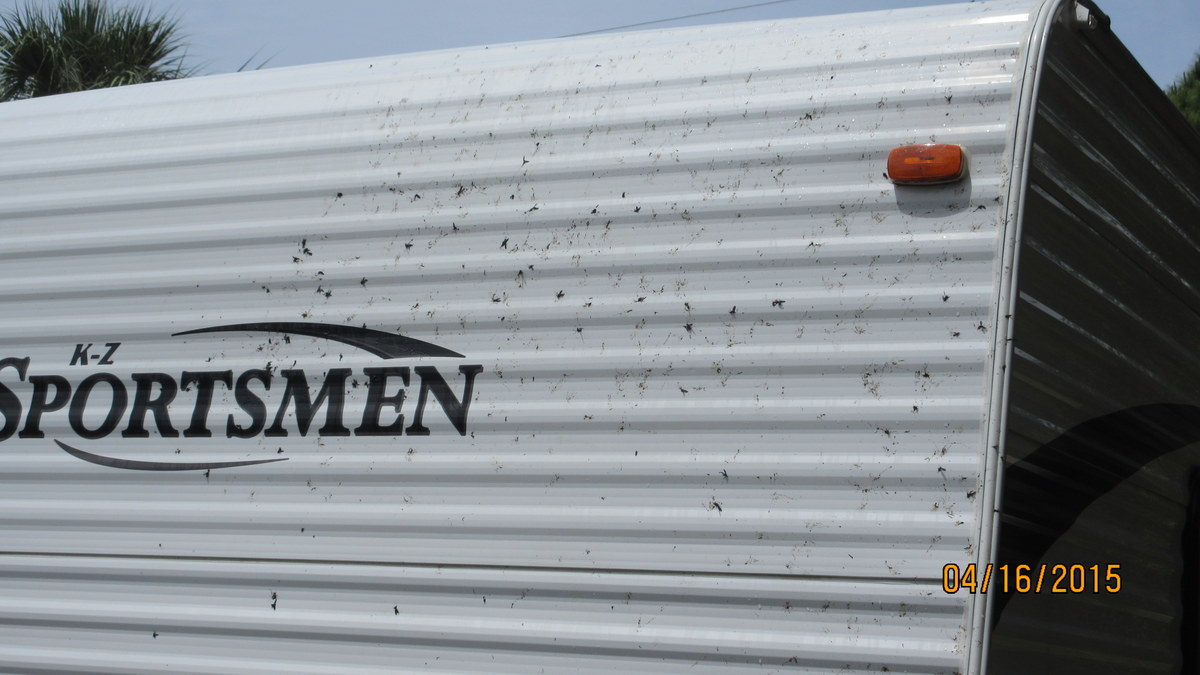
"The adult flies are a nuisance to motorists because the flies are attracted to highways and spatter on the hood and windshield of vehicles. Large number of lovebugs can cause overheating of liquid-cooled engines by clogging radiators. They can also reduce visibility, and etch automobile paint as the body fluids are slightly acidic. If the egg mass and body parts are allowed to remain on the vehicle for several days, bacterial action increases the acidity and etches the paint. A soaking with water for about five minutes followed by a scrubbing within 15 to 20 minutes should remove most of the lovebugs without harm to automobile paint."

Massive 18 wheel trucks have been forced off the road by these insidious insects as their splattered bodies pile up in layers on truck windshields so thickly they completely block the driver's vision. European tourists and people from Wisconsin get out of their rental cars and wonder what the devil kind of cloud they just drove through. Gas stations run out of water and soap and windshield cleaning squeegees by two in the afternoon every day. But, hey, other than that, we had a grand time revisiting Kissimmee Prairie Preserve State Park, located just the other side of the Jurassic Time Warp some 33 miles northwest of Okeechobee, Florida, in Florida's real cowboy country.

The entire trailer has been pressure cleaned, but only half has been cleaned by hand...

We celebrated our new travel trailer's fourth anniversary with a three day stay at this oddly different State Park from Sunday evening, April 12th, until Wednesday, April 15th, almost four years to the week since we baptized our Sportsmen 21 foot unit with our very first stay at the Kissimmee Preserve


 http://sleepstwo.blogspot.com/2011/05/kissimmee-prairie-state-park.html


Main road to the camp ground


My secret desire was to get a photo of the Crested Caracaras that are common in the area, one of the few places this magnificent bird nests in the United States all year round. I saw two on the road on the drive in to the park, but I wasn't fast enough to capture any images with my camera as they flew away. No matter, there were plenty of subjects to keep me busy, from crawfish crawling across the campground after a rain, to a Cottonmouth Water Moccasin that simply wanted to cross the road.


Maury the Moccasin 

Sharon, our camp host named the snake "Maury," and seemed relatively unconcerned about her personal safety, just making sure we didn't harm it as one moccasin had recently been killed by a camper, something that is strictly forbidden in the preserve. Maury was successfully removed to a different, unpopulated area of the preserve by Florida State Park Rangers after his presence was made known to them. Any poisonous snake is removed from parking or camping areas by Rangers as standard safety policy.

It is a unique place, not one most tourists would enjoy unless they are looking for absolute solitude, bird watching, or when the conditions permit, stargazing. Well, almost pure solitude. A run to the nearest town, Okeechobee, is a 33 mile trip, Sebring, in the other direction on Highway US 98 is also about 30 miles. In between the Kissimmee Prairie Preserve State Park and Sebring is the Avon Park Air Force Bombing range, and combat jets on afterburners can occasionally be heard during daylight hours. With the new electronic scoring systems, the environment is spared the old explosions from ordnance actually being dropped into the flat, Florida prairie. Never once did I actually see any aircraft, although they could be heard most mornings in the far distance to the west. They didn't deter the abundant songbirds that continuously serenaded us as soon as the first ray of sunlight peeked through the clouds on the horizon to the east.


A Meadowlark serenades anyone within earshot


The trip to the park was uneventful, but we did take a long way round as I had never driven up the west side of Lake Okeechobee and I wanted to see what I had missed. We drove across most of west Florida on County Road 74 from Punta Gorda to FL 29 just outside Fisheating Creek. Highway 74 is an arrow straight road with only one stop sign the entire 45 miles or so. We come back this way from Miami when we want to avoid I-75. A left turn onto Highway 29, then a quick right onto the four-lane divided U.S. 27, and we headed toward Moore Haven. We turned left on to FL 78 before reaching Moore Haven and headed north toward Lakeport. A nice two lane road, but not as scenic as I had hoped. Not much to see except the rim of the flood control dike that rings the lake. We turned onto FL 721 and drove through the Brighton Miccosukee Indian Reservation en-route to the State Park. We were thrilled to find Garmin has corrected their GPS maps to avoid the platted roads that were never built. We saw our first Caracara on 721 just before the park.


The park is unchanged since our first visit four years ago. The campgrounds are clean, dry and well kept. The showers and toilets are spotless as they were last time and once again, we had only three other campers to share the entire campgrounds during our four day stay. We met Sharon, the camp host and after a good evening walk, headed into the camper to avoid a good, solid three hour rain storm. Drainage is great and we had no problem. We did meet a crawdad, or crawfish, that wandered through the parking lot. I'm sure he ended up breakfast for one of the many crows or hawks that were abundant.


We did make one quick trip into the town of Okeechobee, some 33 miles south, but the Toyota was only moved that one time in four days. A relaxing mini-vacation that we'll do again. We just won't wait 4 years to come back. I'll just double check to see if the love bugs are swarming. Either that or we travel at night.


 [Update: On Thursday, April 6th, 2017, the area was hit with a violent, unexpected storm containing a freakish tornado, which ripped through part of the campsite destroying two campers, a 5th wheel and a Class C on pads 19 and 20. Those are the two pads depicted in this blog. Florida State Parks and the wonderful people at Kissimmee Prairie Preserve State Park, along with the marvelous volunteers and Friends of Kissimmee Prairie Preserve State Park, have cleaned up and repaired the facility to its original state. We look forward to yet another visit - The only reason we weren't there was the sites were already reserved. George]


NEXT: New campgrounds and State Parks as we head north to the Georgia Mountains once again, at:


Featured Post

The Waterfalls Trail

After several days of hiking and walking shorter trails to build up our stamina, we decided today was the day to descend the Waterfall T...