Sunday, August 9, 2015

Experience and planning

When the day to depart on your long-planned vacation finally arrives, you wonder what happened to the last three months? Why am I not ready yet? This time we are pretty much ready, taking a week and a half to secure the boat, have the car checked over and the brakes replaced, put up the hurricane shutters in a controlled, intelligent sequence, clean and pack the clothes, go over our checklist many times, and still, two hundred miles up the road I remember I didn't take my iPod. Or the neat little pocket vial of mosquito repellent that we will dearly miss the first evening. It is sitting on the kitchen counter, not far from my iPod, where we will see it first thing when we get home.

Stephen C. Foster Cultural Center State Park, Florida


But, hey we are on the road yet once again, headed north to Georgia and hopefully cooler and drier weather. We didn't actually head out the driveway until 1:00 in the afternoon on Wednesday, a first for us. We planned to only travel a couple of hundred miles and stop at either the Stephen C. Foster State Park or the Stephen C. Foster Cultural Center State Park. The first one is near Fargo, Georgia, 60 miles north of the cultural center at White Springs, Florida. 

A quick check of ReserveAmerica.com on Tuesday night showed both campgrounds fairly empty so we weren't worried about just dropping in. The Georgia park, however, has a new rate of $35 a night, almost doubling the cost of the last time we stayed there, even with the twenty percent discount for senior citizens. So, our favorite campground at Stephen C. Foster Cultural Center in Florida wins for our first overnight stop. A quick telephone call to the Florida park from I-75 confirms there is plenty of room, and they'll be at the gate until 8:45pm. Since I'm a Florida resident over 65, it will cost $11 a night. Perfect.

Pull-through camp site at Stephen C. Foster C.C. State Park, Florida

Our trusty 21 foot Sportsmen travel trailer obediently trails closely behind, making us pay a hefty penalty in gas mileage, but all in all, we are again happy to be on vacation. We are doing something we have never done before, striking out without making a single reservation. Our general plan is to have fun, play everything by ear, and head for home when we are either worn out or locked out. Or, perhaps both. There are no campgrounds in any state park system, or Federal campgrounds anywhere in the South, and believe me, there are hundreds, that have space available over the Labor Day Weekend. There are zero openings. Playing by ear may not be the sweetest music after all.

One thing I really don't like about towing the travel trailer are construction zones on Interstates. I'm surprised there aren't accidents every 10 or 15 minutes in the narrow, rough, often poorly marked or illuminated double lane changes and detours. Having an 18 wheeler beside you while you are trying not to scrape your trailer's sides off in a makeshift, concrete canyon isn't fun. I knew I-75 north of Tampa is undergoing a massive widening project for about 50 miles, I decided to take State Road 471 from Lakeland north to Baldwin through the Withlacoochie State Forest as an alternative route. The major flaw in my plan is that I have to drive over 20 miles on I-4 to get to Lakeland and that, plus a short drive through Lakeland on US 98, adds almost an hour to our expected arrival time. No matter, the serene, 35 mile drive on 471 through the forest is only interrupted by one other car during the entire trip. As far as I'm concerned, it is the only way to travel. We picked up the Interstate once again at Wildwood after tanking up. We were far on the other side of the construction zone.

While pulling uphill onto the I-75 on-ramp at Wildwood, our Toyota Sequoia's dashboard lights up like the console of the Starship Enterprise. Now what? We pulled off the side of the ramp and shut everything down and tried again. The bright array of lights stubbornly stays on, but everything works fine: brakes, transmission, windows, everything we can think to test. No smoke or fluids boiling over so there is no outward sign of mechanical failure. The Toyota owner's manual is no help what-so-ever. Well, so much for detailed planning. My garage at home is already closed, so I'll have to wait until morning to find out if they can offer any telephone assistance. We start off again, slowly at first, then getting back to cruising speed after a few minutes when nothing major falls off. At least it isn't raining.

We pull into the Live Oak shrouded park at White Springs a little after 6:00 pm, and after a few minutes are on our way to one of the last remaining campsites. The campground filled with drop-ins in just a few hours after we called, but we did get one of the few remaining pull-through sites – meaning we don't have to back in – and were set up in a matter of minutes. It is hot and humid, just like home, so sitting outside is out of the question. Time for a glass of wine and a piece of chocolate.

Day 2


Good news! The lights are off on the Sequoia’s dashboard as I start the truck first thing Thursday morning. Whatever Gremlins were running around the SUV have left, or at least they're still asleep. We take our time eating breakfast and walking Taz before even seriously thinking about where we are going next. Taz, our twelve year old Golden Retriever, balks at breakfast, and for the first time in recorded history refuses to eat. We suspect something wrong with the canned dog food and open a fresh can from a different style of food. Nope, he's not having any of it. He's ready to go home and he isn't going to eat until we do. We walk completely around the beautiful park under the live oaks and Spanish Moss but that does nothing to spark his appetite.


I've always wanted to paddle the headwaters of the Suwannee River at the Stephen C. Foster State Park, near Fargo, Georgia. [While the city, county and most other names are spelled Suwanee, the river itself is usually spelled Suwannee] We've been there before, once even taking our own kayaks, but between bad weather and forest fires, we've never actually paddled there. We figured we'd spend a couple of days and see if we could rent kayaks or at least a canoe and take a look. We put away the breakfast dishes and slowly head up SR 153 toward Fargo, enjoying the ride and waving at people along the way mowing their grass or checking mail. Southern hospitality is no joke.

We stop at the Suwannee River Visitors Center on US 441 in Fargo, but it is locked up tight. We've passed the attractive, modern looking center many times in the past, but the one time we actually try to visit, it's closed. Several pickup trucks with empty, small boat trailers wait patiently in a neat row by the side of the boat ramp. The Suwannee River isn't very high even after all the rains, but it is better than when we were here during the drought five years ago and the bottom of the concrete ramp was fifteen feet from the water's edge.


Suwannee River Visitor Center, Fargo, Georgia


As I pull out of the drive way headed to the Stephen C. Foster State Park seventeen miles away, my dashboard once again lights up, with at least four different warning lights just as the last bar fades from my cellphone coverage icon. 


NEXT: Finally! Paddling the Suwannee, at:


http://sleepstwo.blogspot.com/2015/08/billy-lake.html


Sunday, April 19, 2015

Kissimmee Prairie Preserve State Park, Love Bugs and other Florida Happenings

Love Bug – Plecia nearctica Hardy 
(http://entnemdept.ufl.edu/creatures/misc/lovebug.htm)


"With numerous variations, it is a widely held myth that University of Florida entomologists introduced this species into Florida. However, Buschman (1976) documented the progressive movement of this fly species around the Gulf Coast into Florida."

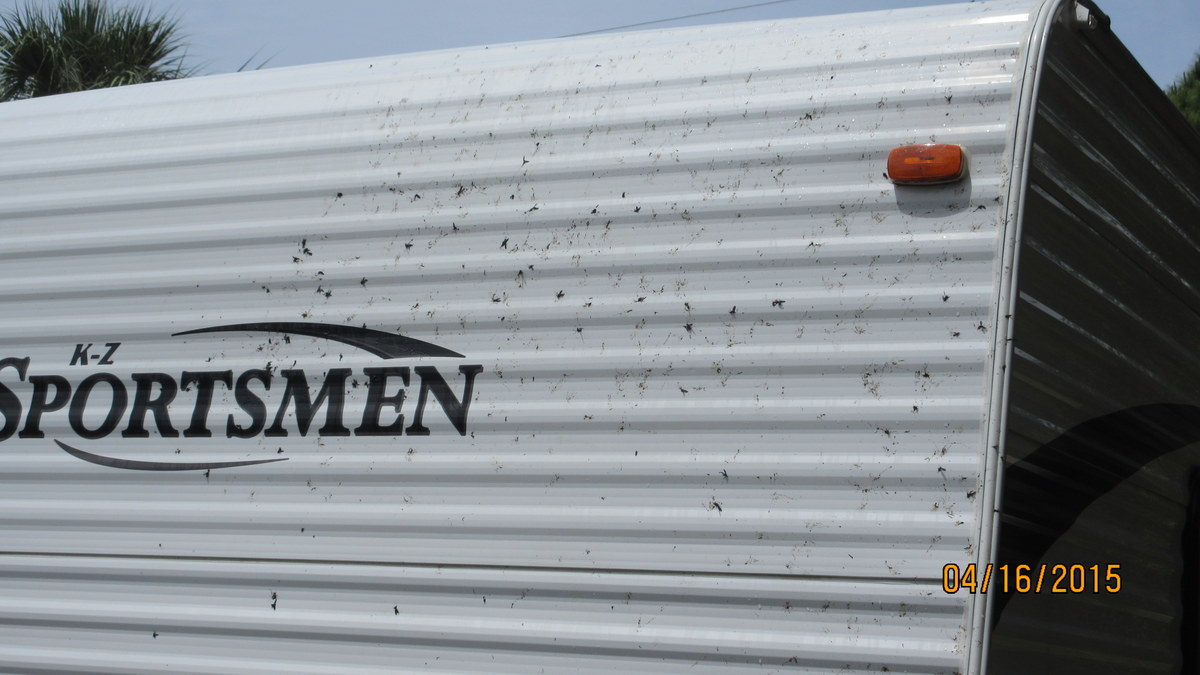
The preceding quote is from the Featured Creatures pages of the University of Florida web site listed above, absolving the Gators from any wrongdoing in the introduction of this odd insect into our daily lives in Florida. Well, twice a year at any rate as they embed themselves into the grill and windshield of any moving vehicle traveling Florida's highways in April and May, and again later in the year during August and September. The common rumor is the University of Florida accidentally released a genetically modified bibionid fly and created this ecological disaster. The rumor is sworn to by any graduate of rival Florida State University.

They are strange insects indeed; they thrive on carbon monoxide and heat, and where better to find that combination than swarming windshield-high over Florida's highways in the blistering heat of late spring and summer. The only month recorded in Florida where one can travel absolutely Lovebug free is November. The U of F web site continues:

"The adult flies are a nuisance to motorists because the flies are attracted to highways and spatter on the hood and windshield of vehicles. Large number of lovebugs can cause overheating of liquid-cooled engines by clogging radiators. They can also reduce visibility, and etch automobile paint as the body fluids are slightly acidic. If the egg mass and body parts are allowed to remain on the vehicle for several days, bacterial action increases the acidity and etches the paint. A soaking with water for about five minutes followed by a scrubbing within 15 to 20 minutes should remove most of the lovebugs without harm to automobile paint."

Massive 18 wheel trucks have been forced off the road by these insidious insects as their splattered bodies pile up in layers on truck windshields so thickly they completely block the driver's vision. European tourists and people from Wisconsin get out of their rental cars and wonder what the devil kind of cloud they just drove through. Gas stations run out of water and soap and windshield cleaning squeegees by two in the afternoon every day. But, hey, other than that, we had a grand time revisiting Kissimmee Prairie Preserve State Park, located just the other side of the Jurassic Time Warp some 33 miles northwest of Okeechobee, Florida, in Florida's real cowboy country.

The entire trailer has been pressure cleaned, but only half has been cleaned by hand...

We celebrated our new travel trailer's fourth anniversary with a three day stay at this oddly different State Park from Sunday evening, April 12th, until Wednesday, April 15th, almost four years to the week since we baptized our Sportsmen 21 foot unit with our very first stay at the Kissimmee Preserve


 http://sleepstwo.blogspot.com/2011/05/kissimmee-prairie-state-park.html


Main road to the camp ground


My secret desire was to get a photo of the Crested Caracaras that are common in the area, one of the few places this magnificent bird nests in the United States all year round. I saw two on the road on the drive in to the park, but I wasn't fast enough to capture any images with my camera as they flew away. No matter, there were plenty of subjects to keep me busy, from crawfish crawling across the campground after a rain, to a Cottonmouth Water Moccasin that simply wanted to cross the road.


Maury the Moccasin 

Sharon, our camp host named the snake "Maury," and seemed relatively unconcerned about her personal safety, just making sure we didn't harm it as one moccasin had recently been killed by a camper, something that is strictly forbidden in the preserve. Maury was successfully removed to a different, unpopulated area of the preserve by Florida State Park Rangers after his presence was made known to them. Any poisonous snake is removed from parking or camping areas by Rangers as standard safety policy.

It is a unique place, not one most tourists would enjoy unless they are looking for absolute solitude, bird watching, or when the conditions permit, stargazing. Well, almost pure solitude. A run to the nearest town, Okeechobee, is a 33 mile trip, Sebring, in the other direction on Highway US 98 is also about 30 miles. In between the Kissimmee Prairie Preserve State Park and Sebring is the Avon Park Air Force Bombing range, and combat jets on afterburners can occasionally be heard during daylight hours. With the new electronic scoring systems, the environment is spared the old explosions from ordnance actually being dropped into the flat, Florida prairie. Never once did I actually see any aircraft, although they could be heard most mornings in the far distance to the west. They didn't deter the abundant songbirds that continuously serenaded us as soon as the first ray of sunlight peeked through the clouds on the horizon to the east.


A Meadowlark serenades anyone within earshot


The trip to the park was uneventful, but we did take a long way round as I had never driven up the west side of Lake Okeechobee and I wanted to see what I had missed. We drove across most of west Florida on County Road 74 from Punta Gorda to FL 29 just outside Fisheating Creek. Highway 74 is an arrow straight road with only one stop sign the entire 45 miles or so. We come back this way from Miami when we want to avoid I-75. A left turn onto Highway 29, then a quick right onto the four-lane divided U.S. 27, and we headed toward Moore Haven. We turned left on to FL 78 before reaching Moore Haven and headed north toward Lakeport. A nice two lane road, but not as scenic as I had hoped. Not much to see except the rim of the flood control dike that rings the lake. We turned onto FL 721 and drove through the Brighton Miccosukee Indian Reservation en-route to the State Park. We were thrilled to find Garmin has corrected their GPS maps to avoid the platted roads that were never built. We saw our first Caracara on 721 just before the park.


The park is unchanged since our first visit four years ago. The campgrounds are clean, dry and well kept. The showers and toilets are spotless as they were last time and once again, we had only three other campers to share the entire campgrounds during our four day stay. We met Sharon, the camp host and after a good evening walk, headed into the camper to avoid a good, solid three hour rain storm. Drainage is great and we had no problem. We did meet a crawdad, or crawfish, that wandered through the parking lot. I'm sure he ended up breakfast for one of the many crows or hawks that were abundant.


We did make one quick trip into the town of Okeechobee, some 33 miles south, but the Toyota was only moved that one time in four days. A relaxing mini-vacation that we'll do again. We just won't wait 4 years to come back. I'll just double check to see if the love bugs are swarming. Either that or we travel at night.


 [Update: On Thursday, April 6th, 2017, the area was hit with a violent, unexpected storm containing a freakish tornado, which ripped through part of the campsite destroying two campers, a 5th wheel and a Class C on pads 19 and 20. Those are the two pads depicted in this blog. Florida State Parks and the wonderful people at Kissimmee Prairie Preserve State Park, along with the marvelous volunteers and Friends of Kissimmee Prairie Preserve State Park, have cleaned up and repaired the facility to its original state. We look forward to yet another visit - The only reason we weren't there was the sites were already reserved. George]


NEXT: New campgrounds and State Parks as we head north to the Georgia Mountains once again, at:


Sunday, August 24, 2014

Upper Limits - A "Star Wars" post [ie: out of sequence]

My glasses are so fogged up I can't see anything, not even the vague shape of our travel trailer that I know is right behind me. I know it's still there, I just can't make it out. 

I stepped out of our air-conditioned trailer to walk Taz, our 10 year old Golden Retriever, after a thunderous night of storms, and before I go ten feet, I am basically sightless as my glasses fog over as if they had been sprayed with paint. Even Taz, our normally nature-loving and free-spirited, four legged family member, can't wait to get back inside where civilization is meant to reside. It is only 8:25 am in the morning.

Even worse, by the time I sit down to write this, just a little after 12 noon, it is exactly 100 degrees Fahrenheit outside. We put our regular trailer thermometer on the table outside – in the shade, of course – and wait 20 minutes for the reading. We know it isn't broken because it soon drops back into the "fit for human habitation" range just a few minutes after I remount it on the trailer wall. If we were watching Star Trek, I'm not sure this campground would be on a class M planet.

We are in one of our favorite campgrounds, the Stephen Foster Cultural Center State Park just north of Lake City, Florida, just a few miles south of the Georgia/Florida border, uh, sorry, State Line. Today though, the massive, Spanish moss draped oaks can't salvage the visit. This isn't fun, no matter how you feel about camping or this beautiful campground.

Ilse and I just spent the last three weeks near Bishop, Georgia, camped at our daughter's house. Instead of heading cross country this year, we spent the hottest part of summer doing our best to help with balancing new jobs and product training by staying with them instead. We had a grand time with the family and of course our granddaughter, but when the time was right, we headed south, back to Florida, rather than heading north to the cooler mountains. We were going to spend some time up in the Georgia mountains just to avoid Florida in August, but we changed our forgetful and forgiving minds and decided to head home.

We spent three days earlier in the year at another of our favorite Florida campgrounds, Anastasia State Park in St. Augustine, with friends who were visiting the area for the first time. That was our only other camping trip this year - that explains the absence of my blogs - besides heading to Georgia. This year was the least time we had used the travel trailer since we picked it up, so we planned a three-day stop at another of our favorite parks at Wekiwa Springs on the way home from Georgia. We stopped at Stephen Foster before heading toward Orlando and Wekiwa, as a pleasant, casual spot we usually enjoy. We are to visit with friends while we are at Wekiwa, so our stop here is just for fun and a good dinner. No reason to rush, we were on vacation after all. I just hadn't counted on the incredible temperature.

Our first warning happened just after we first pulled in a little before 4:00pm yesterday afternoon. I dropped the landing gear and connected everything in record time as sweat poured off me. With water and electric power connected, we cranked up the air conditioner and we prepared to shower and fix dinner, but our air-conditioner kept popping the 30 amp circuit breaker, a first for us. We have never had a circuit breaker shut off on us before. Overload because of too much amperage being drawn.

"Click," and everything shuts down. We put the refrigerator on propane and shut off all electrical service except the A/C just to keep it running and our stripped down, encapsulated environment continues to allow us to live in a relatively comfortable state. We have friends who suffered through temperatures in the 120 degree range while they traveled out west last year, and ended up using 50 amp service – the electrical service plugs usually used by the big Class "A" and Fifth Wheel RV units - just to keep their A/C running. Now I understand why.

Ilse and I have already decided that suffering for fun isn't something we're prepared to do. Somehow, we just aren't into masochism as an entertainment venue. It now appears we should have extended our trip up north rather than head back two weeks early. Oh well, we're here now. Time for a glass of wine.


NEXT: Kissimmee Prairie Preserve State Park, Love Bugs, and other Florida tidbits, at: 

http://sleepstwo.blogspot.com/2015/04/love-bugs-and-other-florida-experiences.html

Thursday, August 29, 2013

Routines and Habits - Hard Labor Creek State Park

Routines can be unexpected. Seriously, you may not even know you are in a routine until it is interrupted by something out of the ordinary that suddenly defines the routine you didn't know you were in. Since this is a blog, I should put a smiley face here, but I will suppress any wild desires to succumb to the current idioms.

An unrecognized routine may expose itself at the strangest of times, such as the power going out when you turn on the air conditioner in your travel trailer. Ooops! What did I blow this time? Check all the circuit breakers in the trailer power supply. Turn them all off and also turn off the suspected offender, the AC unit, then flip all the circuit breakers back on again. Still no power, even without turning on the air conditioner? Head outside to the campsite power box behind the trailer and double check all the circuit breakers. Flip them all off and back on again, still absolute quiet from the camper. In fact, the whole campground is silent. Aaah, now, there's a clue! Our routine dictates we start with what we expect the problem to be and work from there.

The camper up the hill from us is yelling instructions to his wife who is inside the trailer while he is also outside fiddling with the power box, just like I did. Obviously, this is bigger than both of us. One of the camp-hosts soon toodles past us in his state-park green golf cart, headed uphill toward the camp office. I yell at him and he responds, “I'll find out what happened, back in awhile...” and he continues putt-putting up the hill.

Our camp-host comes back by fifteen minutes later and apologizes for the outage, which he believes will be fixed in an hour or so. It seems the camper up in Site 2 pulled his trailer out of the campsite without unplugging his electrical cord from the service box at the side of the campground. He ripped the electrical service box completely out. Unfortunately for us, and him, he forgot to double check his trailer before he pulled out of his campsite. Leaving became routine for him, but he didn't have a routine. See what I mean?

That's why we religiously have an “Over and Under” check before we pull out of a campsite. The “over” part makes sure we have the TV antennae retracted before we pull out from under the trees and the “under” part makes sure there are no cables, water hoses, or trailer jacks still in the down and locked position before I pull out and rip them off. If I can't see unobstructed under the camper, we simply don't leave! Then we always stop and look back to make sure we haven't left the dog behind, or maybe a chair or something. We have our routine.


As I check the sites around us I realize there is a Direct TV satellite television receiver mounted on a sizable tripod sitting a hundred yards from us in the middle of the campground. There is no trailer or RV close by, the receiver seems to be sitting by itself in the middle of the Georgia woods. The closest camper is the fellow up the hill who was yelling at his wife about the power outage. Actually, he is camped a good fifty feet away from the antenna but it turns out to be his. It is attached by a coax cable that must be 300 feet long. Slowly it dawns on me this is the first weekend of college football!

More importantly, we are not far from Athens, home of the Georgia Bulldogs who are looking to maul Clemson day after tomorrow in the season opener. The football game will be at Clemson so no loyal Georgia fan would want to miss that! Therefore the satellite antenna. And that is why we need electrical power at our campsites! Seriously! Routine is is what routine does. Thank you, Forrest!

Tuesday, August 27, 2013

The Dark Side of Camping


When friends ask us about our experiences camping, they occasionally ask us what we consider the least favorable part of RVing, our civilized version of camping. You know, is there a part of RVing we really dislike? 

While I don't care for the constant semi-truck trailer traffic on the Interstate highways, or having three or four days of constant rain while confined to a muddy campground, or especially inconsiderate pet owners who don't leash or clean up after their dogs, there is one specific item we dislike that takes first place. The thing we dislike the most is a result of one of the activities made attractive by camping close to nature. Too close to nature as it turns out. Chiggers!

We have many camping friends who have never been bitten by chiggers. Many of my friends have never even heard of them. In fact, the Germans don't even have a word for them. They call them “sandfloh,' or sand fleas, which they definitely are not! Chiggers are not even insects, they are arachnids, the same family as spiders and ticks. We have sand fleas in Florida – where we call them 'no-see-ums' – and they are quite mild by comparison to chiggers. In fact, they are almost pleasant next to the little, almost invisible, flesh-eaters that can spoil a vacation faster than bad weather. 

My mom used to call them redbugs. They were a normal part of Blackberry picking on the family farm in North Carolina. You don't need to be a camper to have one of nature's worst biters chew up your ankle, all you have to do is walk in green, tall, wet grass where the adult mite, Trombicula alfreddugesi, has laid her eggs. Damp or wet grass happens to make a really great home for the little stinkers. It takes high humidity or moisture for the larvae, and they are normally found close to the ground, you know, foot level, or not much higher than your shins. That's where their normal hosts, rabbits, opossums, raccoons and just about anything else at ground level, run around. Unfortunately, green, tall, wet grass can be found on almost any overgrown hiking or bicycle trail. Especially the trails that encircle most  campgrounds. Especially summer campgrounds. We've actually picked chiggers up in mowed fields.

Look Closely! At only 1/150th to 1/120th of an inch in diameter, they are barely visible 


Our pre-teen daughter called from a central Florida girls' summer camp one year and said we would have to pick her up early as the camp was being closed down early due to a severe measles outbreak. It seemed every child in the YMCA run camp had been infected with the disease and the camp medical staff had no choice but to send everyone home. We thought that was really odd as our daughter had the measles when she was in elementary school. 

We met her several hours later at the pick-up point along with a bus filled with scratching, red blistered young girls and realized they weren't measles ridden at all, they were all covered with chigger bites. The medical staff at the summer camp had never seen a chigger bite and misdiagnosed the symptoms! They assumed they had a medical emergency on their hands! They did, but not the one they thought.

Chigger bites are not fun. The insidious bites don't peak in their horrible itching and pain for two or three days, and they take about two weeks to heal past the scabbing phase. Even then they leave blotches for another week or so. 

Scratching the bites once they have crusted simply starts another round of intense itching and the healing process starts all over. The bites are insidious because you don't have any idea you are being attacked while the little bugs, or buggers, depending on your viewpoint, are busy inflicting wounds you will regret for weeks to come. You can not feel them bite or even crawl up your skin as they look for a soft, easy place to attach themselves, so you have no idea they are there. You may be standing in a field of them being attacked by the hundreds and not feel a thing. Not for 8 to 12 hours anyway. And they seem to attack in bunches. That's because the adult lays 3 to 15 eggs in a cluster, usually under a leaf or a blade of grass, and if you brush against the leaf or blade of grass and pick up one chigger, you probably get them all.

Chiggers are almost invisible, being only 1/150th of an inch long, and oddly enough, in the larval stage, have six legs, making them look – under a microscope – like insects. The last two legs develop soon enough to expose the true nature of the little red beasts. 

Chiggers are arachnids. In other words, they are in the same family as spiders and ticks. They are not flies or gnats. Technically they are Trombiculidae mite larvae, and in another of nature's quirks, once they develop into adults, they are harmless! 
 
According to Wikipedia:


After crawling onto their hosts, they inject digestive enzymes into the skin that break down skin cells. They do not actually "bite" but instead form a hole in the skin called a stylostome and chew up tiny parts of the inner skin, thus causing severe irritation and swelling.”

Sound like fun? The little stinkers don't actually bury themselves in your skin the way ticks do, and can easily be removed with soap and water, even a brushing with a towel or cloth can remove them before they settle in for dinner. If you give them a head start, however, you are in trouble. Going to bed without getting them off is a real treat as they then can wander over your whole body looking for tender parts. Believe me, they will find them. After they find a nice soft fold in your skin, like your groin or even your navel or a similar tender target, they drill a tiny hole in your skin and shoot you with a really ingenious chemical that causes another, really unique reaction from you, the human recipient.

The digestive enzyme they shoot you with is a meat tenderizer and no amount of clear nail polish will fix the wound. Being protected from the air may give topical, temporary relief, but in the long run nail polish is a remedy that doesn't offer much relief from a chigger bite. That's because your body builds a defense around the intruding enzyme that is destroying your tissue and actually encircles the attacked skin cells as a protective barrier. The result is a hard, crusted tunnel, filled with a digestible mixture the chigger then happily feeds on. After 2 or 3 days, the now satisfied larvae drops off and enters its next phase of life. You are no longer needed, but the feeding-tube reminder left in your body will drive you crazy for the next two weeks. That remaining stylostome and your body's reaction to the enzyme are the problems.

Hydrogen peroxide has been recommended as a topical agent, but again, the relief is only from the cooling liquid as the enzyme, or protein doesn't dissolve or react to the Hydrogen Peroxide. Even common bleach, such as Clorox, has been recommended as an agent to off-set the enzyme, and may actually be one agent that helps diminish the chemical reaction. I'll let you know by next week.
In the meantime, I use a commercial product called Chiggerex®. It has the anti-itching components recommended by all the “experts,” such as Benzocaine, Aloe Vera, Chamomile, and a label full of other chemicals. We find it offers the best relief for us. [This NOT an endorsement! Find your own cure and don't bother me about corrupting my amateur blogging status! On the other hand, if you find something that works for you, let me know.] 
 
Some people prefer Ammonia based agents such as AfterBite®, or different types of Calamine lotion to get through the agonizing itching. The only thing we know that works for certain is time. Two weeks of it. If I ever quit scratching.
[Post Script: In researching the article on chiggers, it became obvious only several reference articles formed the basis for the hundreds of web pages containing information on chiggers. Much of that information was simply cut and widely pasted across the Internet. I eliminated untested or documented pages and “cures.” Apparently no ideal solution exists for relief of chigger bites. There are “home remedy” recommendations from fingernail polish, bleach, vinegar, petroleum jelly, even applying a salt wrap. There seems to be no single antidote to the chigger's enzyme, but plenty of mis-information about the animal and its bite. I therefore add the following statement: 
 
Because chigger wounds are a complex combination of enzymatic and the resulting mechanical damage, plus allergy and immune responses, plus possible secondary bacterial infection subject to local influences, no one remedy works equally well for most people.”
 
My humble thanks to the University of Maryland, Iowa State University, and many other formal institutions for their published papers on chiggers. ] – George

Sunday, August 25, 2013

Hard Labor Creek State Park

One of the benefits of Hard Labor Creek State Park for us is that it is only 17 miles from our daughter and her family's home, near from Watkinsville, Georgia.

It was a pleasant, uneventful tow down from Richard Russell State Park near Elberton, and took us only an hour and a half or so. We found we won't be able to stay in any Georgia State Park over the Labor Day weekend in our RV as every campsite site is already reserved! All the campsites at Watsadler and the other U.S. Army Corps of Engineer campgrounds are also booked! Only for the Labor Day Weekend, though, then they are all practically empty! That doesn't help us, but we have a week until we have to check out, so we decided to make the most of it.

Site 26 at Hard Labor Creek state Park


We arrived at Hard Labor Creek Sate Park knowing we would have to vacate after only a week's stay. We simply hadn't made reservations early enough! Not being able to stay over the Labor Day weekend means we have to arrive at our daughter's place several days earlier than we planned, but as long as they don't mind, neither do we!

Checking in at Hard Labor Creek State Park was a pleasant experience. Registering at all of the Georgia State Parks we have stayed at in the past have been pleasant. The volunteer at the registration desk was friendly, pleasant, and made a suggestion that was worth its weight in gold: She said to turn on our hot-spot as we drove through the campground looking for an available campsite. The area is known for not having cell-phone coverage or Wi-Fi, but, she said, there were several areas that had cell-phone coverage, it just wasn't universal for the entire campground.

Taz meets a camp host piece of yard art

We drove slowly around the beautiful but narrow campground and found we indeed did have cell-phone coverage in certain areas. Let me 'splain, Lucy! Our hot-spot is Virgin, which in reality is Sprint. Our cellphones, and Ilse's smart phone, are on Verizon. Normally, the Verizon units chat away without problem while the poor Sprint connection seems to falter every time we try to log on. Many times we wished our hot-spot was a Verizon unit because we would like to be on the Internet if we can get cellphone coverage. The Sprint unit usually seems to be searching for a cell tower while our cellphones happily connect us with the world.


OK, hotspots are nothing more than cellphones that speak digital data rather than voice. Each hot-spot has a cell phone telephone number that connects it to the nearest cell-tower, just like your cell phone, only it doesn't pass information in the audible range for the human ear. Rather it translates the cell-tower stuff to high-frequency data and looks for something digital to talk to, such as your computer or tablet. It is an intermediate device – so is your cell phone – but it can handle five devices if you are on a 3G network. If you are a high-speed 4G network, most hot-spots can handle up to ten devices simultaneously. OK, this is getting deeper than I wanted. Just understand a printer can not be added as the functions of a hotspot are not the same as your router at home. Any more information will cost you $125 dollars an hour.


The nearby Apalachee River from Price Mill Road


Here is the kicker: Our vaunted Verizon cellphones were dead as doornails while our poor little Virgin/Sprint hotspot hummed away as long as the battery would last! I'm posting this blog through our little Sprint/Virgin hotspot, and will continue to check e-mails and the Internet every chance we get. The camping spot we picked not only has 3-bars – if you don't know what that means, this whole blog is a moot exercise – and has privacy, and plenty of room as we expect company during the week we are here.

So far we are impressed with this relatively unknown Georgia State Park. Clean, quiet, and well laid out with spotlessly clean facilities, we simply should have made reservations earlier!

NEXT: The Dark Side of Camping, at:


http://sleepstwo.blogspot.com/2013/08/the-dark-side.html


Wednesday, August 21, 2013

Lake Richard B. Russell State Park


As we sit here in our absolutely empty campground on the banks of Richard B. Russell Lake, we wonder if we are the only people on earth. Well, not really, but it is amazing we have had four days of this beautiful locale all to ourselves. It quit raining two days ago and things are almost back to normal. Scratch the campfire though, the firewood probably won't dry out until next May. We did get to see some of the Blue Moon last night, the first time the overcast has broken since we've been here.


The only other guests have been Jade and Tom, who we met up in Asheville, but they only stayed one night as they were headed home to Sarasota and stopped only as a layover on their way home. It was still raining then so I don't blame them. There is one new tent over on one of the very first campsites, but he stays to himself and could be dead for all we know. He hasn't been seen since he set up his tent three days ago.

We just had a fawn -- she still had her spots -- wander between us and the nearby lake a few minutes ago. Taz was busy watching squirrels on the other side of the campground and didn't see the young intruder as she non-nonchalantly wandered through our campsite, stopping occasionally to nibble on some new found growth. The fawn never looked up, she had no idea we were here, and Taz never looked over, he had no idea she was there. Really unique! They were only yards apart, yet neither knew the other was there. These are priceless moments.

However, there is a dark side to camping. A price to pay, so to speak. No matter what precautions you take, something seems to always slip in and bite you on the ankle. And on the shin. And on the thigh. And on the soft, tender flesh that can extend all the way to your armpit: chiggers! 

Ilse found them, or vice-versa, while standing in a recently mowed trail that led through a grass field while making a cell phone call. Oddly, I didn't suffer the massive attack and I walked only a few feet away from where Ilse walked! To say the scores of the little buggers has put a crimp in our life style would be an understatement. Ilse is on the verge of intense discomfort, which is to say, pain. Which translates to: DON'T TOUCH ME! Unless, of course, you want to help me scratch!

I don't take it personally, I have had chigger bites in some very personal locations that caused me to consider castration as a remedy. They are nasty little buggers! These are the things Coleman and Camping World conveniently leave out of their media ads about the joy of sleeping outdoors. Time heals all wounds. Hopefully.

We had another surprise as we tried to make reservations at a nearby park we haven't used before, Hard Labor Creek State Park, for the Labor Day weekend. All sites had already been reserved for the entire three-day weekend. Same for Watsadler, and even the park we were in, the Richard B. Russell State Park, which has been almost completely empty since we arrived almost a week ago! 

The locals pile into every available campsite all over the south for an end-of-summer ritual, and if you don't reserve early, you are like us: SOL! Which means, of course, Should of Learned! [Yes, I know! It should be SHL, but that doesn't make it funny...]

Our daughter invites us to park at their place over the Labor Day Weekend, so we only have to reserve a spot up until that Saturday at Hard Labor Creek. Then we'll move to her place for a few days before we head home. 


All is well in the world. We will get to spend extra time with our granddaughter, which is always a plus, and we won't have to suffer Genghis Khan and his juvenile hordes as they see how much toilet paper they can stuff in the men's room toilets.


It's what you do with what you've got that counts.


NEXT: Another Pleasant Surprise, at Hard Labor Creek State park, at:


http://sleepstwo.blogspot.com/2013/08/hard-labor-creek-state-park.html 


Featured Post

The Waterfalls Trail

After several days of hiking and walking shorter trails to build up our stamina, we decided today was the day to descend the Waterfall T...